Saturday, July 29, 2017

HMS Agamemnon; Nelson's favorite...

. . . but maybe not mine, so much.  I found the "Eggs-and-Bacon" in a Langton boxed set for sale on eBay.  Since I need it, and all the other ships in the box for Trafalgar, I went ahead and picked it up. The Agamemnon was already painted and assembled (but not rigged); however, I wasn't happy with how the masts had been done.  So, I disassembled, stripped, repainted and reassembled the ship.

Rigging was where my problems really started.First I tried a different type of thread from what I normally use. Other people get good results with it, but I didn't, as it frayed and unraveled at the slightest provocation.  So, I cut all that out and went back to my normal thread.  Then, I discovered that I had rigged part of the stays incorrectly when using my normal thread , so had to cut all those out again.  No excuses here, this was completely my fault.  After all, "I've built almost a hundred of these things, so I don't need to look at the instructions."  WRONG!  I got that part redone, and all the ratlines on her.  That's when I dropped the ship.

Rather than let it fall, I tried to catch it.  That meant it bounced down my legs and THEN hit the floor.  Fortunately, the standing rigging worked like it is supposed to, and I was able to pull all the masts back into line without anything breaking.  There are no pictures of this, as I suspect my obscene language at the time would have turned any photographs a fine shade of blue.  There were some minor mistakes in the running rigging, but I was able to catch them before they were baked into the ship.  I guess the moral of this story is either:
  1. No matter how many times you've done this, read the stinking instructions, or
  2. if you're a beginner, don't be afraid of making mistakes.  We all still do, no matter how much experience we might have.
Now, with all that out of the way, let's get to some photos.  In my attempt to get at least one blog post up this month, I didn't set up my usual system of lights for taking photographs.  However, I still think they came out OK.
Looks like there might be some debris on the Captain's sternwalk.
Even with all the issues and my clumsiness, she's still a pretty good looking little ship.  Credit for that goes to the original design and the sculpting skill of the Langtons.

While it sounds like this Agamemnon might be a hard-luck ship, I'm hoping that isn't the case.  In fact, unlike many of my ships, she will make her first appearance on the game table next month in a "what-if" scenario that, had it occurred, she would have been a participant in.  I'm hoping she can extinguish some of the bad luck from her building on the game table.

Saturday, July 1, 2017

They're Not Targets, They're Merchants!

Too often, naval gamers are guilty of thinking about merchantmen only as targets for well, pretty much everything else on the table really.  In fairness to those gamers though, game rules usually treat the lowly merchantman as nothing more than a target.

I think it takes a campaign game for the merchantman to truly come into its own.  We think of supply convoys as belonging to World War I or II, but this is not the case.  Even in the Napoleonic Era, armies had to be fed and supplied  and navies did as well.  After all, sometimes the most convenient ports for your naval strategy are not the richest ones where supplies are concerned.  Escorting a convoy of food and supplies through a rapacious enemy squadron can be a fun scenario for us,  but was a recurring duty that Admirals from all nations faced during the Age of Sail.  No matter what sort of naval campaign you want to run, the simple fact is that you're going to need merchant ships.

With that in mind, here are some pictures of those unloved workhorses, my merchant fleet.  At the risk of sounding hypocritical, I'm not going to show individual ship photos in this post.  Instead, I'll break them down by manufacturer, and only show an individual photo if it's a one-off ship.

Most rules break merchants down into different sizes, and so it makes sense to start with what most rules call "small merchants."  There's not really a hard, fast rule about where the size break is between a "small" merchantman and their larger relatives.  For our purpose here, if the maker of the miniature calls it a small merchantman, then it's a small merchantman.

First up are the models originally from Skytrex, now sold by  Red Eagle Miniatures (http://www.redeagleminiatures.co.uk/). These first two are called "bark" on the website, but as you can see in the photos, the mizzen mast is not fore-and-aft rigged. 
The sterns on these ships are completely smooth, so you can detail them however you like.  Looks like the owner of the left ship didn't do a very good job of fake windows.

Skytrex sold the ship pictured below as the troop transport Buffalo, but Red Eagle just calls it a generic troop transport.  I think it makes a perfectly good small merchant, and Red Eagle must agree with me because that's what they have it listed under..  I don't like the Skytrex sails and masts, so for this one I replaced them with a small frigate set from Langton.


Another one-off ship is the West Indiaman from GHQ.  As with all the GHQ sailing ships, the hull is beautiful but the masts are flimsy and I find their ships hard to rig without bending the masts.


Next we come to the mainstay of my small merchantmen, the Langton small merchant.  The hull form is very similar to the Skytrex bark, except that the Langton hull has side galleries and decorations on the stern. 
The ship on the far right of the photo is a purchased one.


Even my Langton models have a one-off, however.  The ship below is a small Great Lakes schooner that I bought just to see how small they are.  As you can see from the photos, the answer to that is, "pretty darn small."


Up next are the medium merchants, and I only have two of those. The first one is from Langton
This is a purchased ship, and I just realized there is no running rigging.  Oops!


When I bought the ship pictured below from Skytrex, it was listed as, "medium merchantman The Pitt."  Red Eagle lists it under the same name, but calls it a medium East Indiaman.  To me though, she looks a little small to be an East Indiaman, and so that's why it is on a base size that Langton recommends for unrated vessels.


Finally, we have those big boys, the Large Merchants.  When handled aggressively, they can even convince a cautious enemy commander that they are ships of the line, instead of targets.  For a quick  example of this, see the Wikipedia article about the Battle of Pulo Aura, fought on Valentine's Day in 1804 (https://en.wikipedia.org/wiki/Battle_of_Pulo_Aura).  In looking at the pictures of these large merchants below, it's easy to see how a case of mistaken identity could come about
Fly the right flag, maneuver aggressively, and it just might work.

I think there is only one stern design for the Langton large merchant


This is a purchased vessel.
Skytrex/Red Eagle also puts out a large merchant, and while smaller than the Langton one, it still looks the part.

I do have some other ships that could be used as small merchants: poleacres, xebecs, and a lateen-rigged barque.  They are more limited in where they could be used though (they are primarily Mediterranean rigs), so I will put them in the post on unrated vessels.

Wednesday, June 7, 2017

A Quick Thanks to A Reader

In a discussion on TMP, there was a general agreement that shore batteries and forts without some sort of  crews around the guns just don't look right.  At the same time though, there was some disagreement on the best way to make sure those guns are manned. A consensus seemed to form that most 1/1200 gun crew figures are, at best, lumps of lead.

One suggestion I found interesting came from Vol, the owner of a sailing ship blog located at: http://volsminiatures.blogspot.com/.   He suggested using some 1/800 scale photo-etched brass naval crew figures from Eduard, a Czech company that specializes in accessories for plastic model ships.  At first I was afraid they would be way too large; after all, 1/800 scale is 66.7 feet/inch while 1/1200 is 100 feet/inch.  In metric, that means that 1mm in 1/800 equals 2.62 feet while 1mm in 1/1200 scale equals 4 feet. That still sounds too big.  However, when you divide it down some more, a 6 foot tall man is 2.28mm in 1/800 scale while that same man is 1.5mm tall in 1/1200.  That's a difference of less than 1mm, which meant I was willing to take a chance on them.  I found a set on eBay, and they arrived while we were away on vacation.

One thing's for sure: They are small.  They come pre-painted, and there are about 500 of them on a fret.  This means that there are plenty of spares when you drop one after cutting it out (and you will drop a few; trust me on this).  The main question though is, how do they look in a shore battery?

Well, they look pretty good actually.  Below is the two-gun battery that I showed in a post about some ACW ships that I bought.  As you can see, it does look pretty bare:

Now here's how it looks with some of those Eduard figures glued in:

Now that battery looks like it's open for business!  So, a rousing "thank you" to Vol, who turned me on to these figures.

Tuesday, May 16, 2017

More New Construction

This ship has been sitting on the desk since March, waiting on its running rigging while I've gallivanted around doing other things.  So, last night I sat down and finished off this ship.

She's another Spanish 74, but painted in a very specific scheme.  I based this one on the painting of  Nelson in HMS Captain  capturing the Spanish San Nicolas and San Josef at the Battle of Saint Vincent in 1797.  You know, this painting:

L to R: Captain, San Nicolas, San Josef

Technically, San Nicolas was an 80 gun ship and not a 74.  Since the ship I used has stern decorations unlike any of my other Spanish third rates, I think it turned out OK.  The painting (by Nicholas Pocock, so we can be sure it's accurate) doesn't show much of the Nicholas' stern and nothing of the head, which means I could take some liberties there also.  So, with that in mind, here's the newest member of the family, a Spanish 74 painted like the San Nicolas.


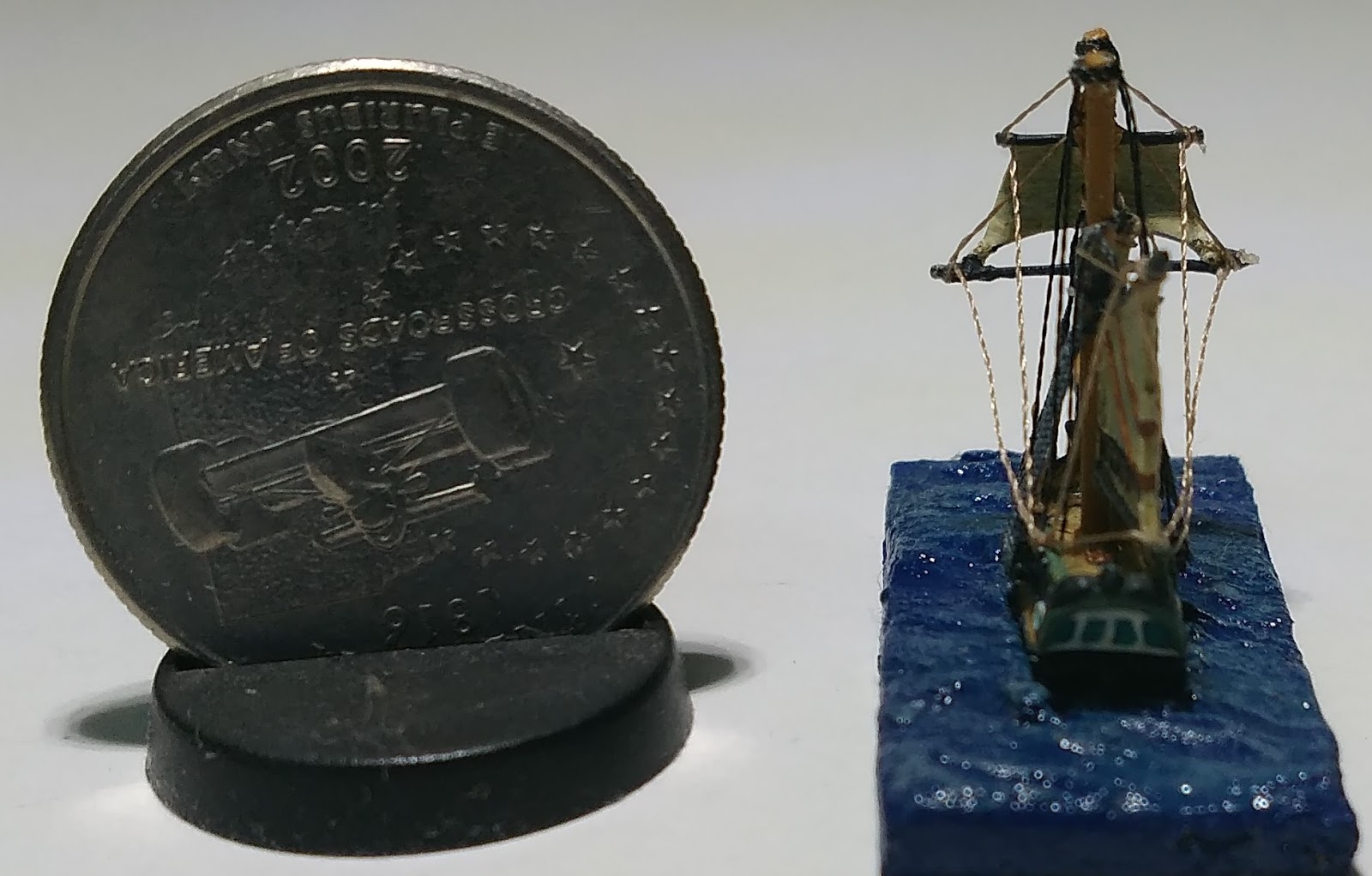
As always, a shot with the Quarter of Comparison™

Unique stern decorations for a Spanish ship (so far, anyway).


Monday, May 15, 2017

US, Russian and Dutch fleet photos

Here we have the smaller fleets in my collection: the Americans, the Russians, and the Dutch.  Since two of those three navies used white stripes for decoration, we have the above title.  Most people think that the white stripe along the gunports was a uniquely American paint scheme, but this isn't true.  In fact, the Russian Navy adopted the scheme first, during the period 1796-1801.

First up is the United States Navy.  The first pictures below are the Constitution.  Although I purchased this one, it is modified and somewhat repainted.  I added the gunports but as my latest book shows, even in 1812 she used the split gunports.  So, I need to change these at some point in the future.  Might be time to do a little bit of re-rigging as well.


Next up is the sister ship of the Constitution, the United States.  Also known as "The Old Waggon" due to her lackluster sailing qualities, I built this ship from another Constitution model.  I added the roundhouse on the upper deck and the additional galleries needed.  I based the stern on the old Revell model of the ship.

OK, so not all the US ships are painted with white stripes
Kinda proud of the stern, since I did it a good while back.
Now, I would probably add more detail.
 Next up is what Langton refers to as the USS Congress.  One of the original six frigates, Congress never had a very distinguished career.  She can however be used as her sister ship Constellation and I would even use her as Chesapeake, although she might not be completely correct.


Last up for the Americans is the USS Essex.  This mini was one I purchased.


The next act in our White Stripes get-together are the originators of the scheme, the Russian Navy.  Of course, not all of them are painted that way either, as you will see below.  First up is a 32 gun frigate:


This next ship is the oddball of the bunch.  Langton calls it a 46 gun heavy frigate, but the gunport arrangement doesn't match anything in Tredrea and Sozaev book, Russian Warships in the Age of Sail.  So, I'm considering it to be one of the 46 gun Pyotr Apostol class of frigates.  Since most, but not all of these, were out of service by 1800, I decided not to go with the black/white scheme.


The next unfinished ship is a 50 gun heavy frigate.  I haven't gone through the book trying to figure out which class this one is, but decided to give it the black/white treatment since there were large frigates around during the 1806 Russian-Ottoman war (which is my interest).


Next up is a 66 gun ship, which was the standard small SOL of the Russian navy.  These serve throughout the Age of Sail.


Like all other navies, the Russians built large numbers of 74 gun ships, and they see extensive service in both the Baltic and Black Sea theaters, along with the other areas the Russian navy ventured into.  For example, in 1798-1800 they actually cooperated with their long-time Ottoman enemies against the French!

A very no-nonsense looking ship.


The last ship for the Czar is the 100 gun three-deck SOL.  Even in confined waters like the Black Sea the Russians kept several of these.  This particular miniature probably represents a ship of the Ches'ma class, which may or may not be based on the design of HMS Victory.


Last in this post are my Dutch ships.  "Fleet" is a bit much, since I only have two ships.  There is not much information available in English on the painting and decoration of Dutch ships during this time, unlike the earlier 17th Century.  Before I build any more of this navy, I want to find more information.  These are painted based on information from the Langton website.

A 54/56 gun SOL. This one is riding a bit low in the water; might need to
redo this base.


A 64/68 gun SOL.  Dutch ships tended to be smaller than those of other nations.