Showing posts with label first rates. Show all posts

Monday, December 2, 2019

Ray-o, Ray-ay-ay-o!

The last two posts shared a title, since both of them were about the Texas Broadside convention.  In case you didn't recognize the line, it's from a Jimmy Buffett song entitled, "A Pirate Looks at Forty."  Since my main game was about capturing prizes in the Age of Sail, I thought the lyrics of the chorus fit pretty well:
Yes I am a pirate
Two hundred years too late
The cannons don't thunder, there's nothing to plunder
I'm an over forty victim of fate

  For the title of this post, I've gone a little farther back in time than 1974.  Even with that, for those of us who are "of a certain age," this one should be an easy guess as well.  Just as with the previous title, this one is modified but only very slightly.

Our subject this time is the Spanish 100-gun ship Rayo, which according to Google Translate means "Thunderbolt" or "Lightning" in English.  Yes, I skipped the obvious Bohemian Rhapsody jokes, and yes, you're welcome.  The history of the real ship is pretty interesting, which is why there's a brief history lesson before we get to the usual pictures.

She was originally launched in 1749 as an 80-gun ship of the line named San Pedro, and was commissioned into the Spanish Navy in 1751.  She had the usual spells of activity and idleness during her career, and was laid up from 1798 to 1803.  She was thought to be in poor shape by 1803, but her construction from tropical hardwoods (she was built in Havana) meant that she was still mostly sound.  She was taken and converted into a 100-gun ship in 1803 by enclosing her upper deck, similar to how Santisima Trinidad went from 112 to 136 guns in 1795-96.  By January of 1805, Rayo was in Cadiz.  Later that year, she joined the Combined Fleet after it returned from the West Indies.  She fought at Trafalgar, returned to Cadiz, and sortied again on October 23 to help recover the ships Santa Ana and Neptune.  She was then driven ashore and shipwrecked in the storm following the battle.  She was the oldest ship at the battle, being about 14 years older than HMS Victory.

This particular model turned out to be a learning experience in more ways than one.  Langton has begun casting its larger hulls in resin instead of metal, and this was my first experience working with one.  Overall, the detail is every bit as good as the white metal hulls.  Unfortunately, this model had damage to the starboard quarterdeck bulwark that would have made it impossible to run rigging lines.  It looked like it had been broken instead of not having enough resin in the mold.  Fortunately, I had some .010 plastic sheet, and a couple layers of that, combined with a bit of carving to shape,
made for a fairly quick repair.

It's easy to see the difference between resin and metal detail in this photo.
Also, you can see the repairs to the quarterdeck bulwark.
The sharp-eyed among you have already noticed other pieces of black plastic as well.  Another problem with this hull is that some of the channels for the ratlines seem to be positioned incorrectly.  Instead of ending in line with the hole for the mast, they end before the hole.  Consequently, the brass ratlines should not align properly with the masts.  The next picture will give a better idea of what I mean:


It is kind of a big deal.  As the plan of HMS Serapis below shows, the ratlines have to line up with the mast.


In fairness though, the Spanish 80 gun hull from Langton has the same problem, so I should have expected it.  Unlike the metal hull, this resin one made a repair much easier.  Take a piece of the .010 plastic sheet mentioned earlier, cut to roughly the right size, and glue them on.  I had thought that I might have to support them from below, but once the glue dried they were remarkably sturdy.  I won't say it's a perfect solution, but once paint is applied you can't tell the extensions are there.  I should probably have trimmed the back of the channels to make them a bit smaller, but didn't want to run the risk of damaging them.

Other than that, painting and basing went mostly as expected.  I decided to paint the ship based on some pictures I found on a website called Todo A Babor:  https://www.todoababor.es/  .  If you're interested in the Spanish navy, then put this website in your bookmarks!  There are articles, paintings and information on the Real Armada that I've not seen anywhere else.  There is a definite shortage of English language information sources on the Spanish navy out there, and this is a useful corrective.  The website itself is in Spanish, but Google Translate handles this quite well.  Some of the more specific nautical terms may be mistranslated, but you can still figure out what they mean.  Todo A Babor has a couple of different color paintings of Rayo, but I decided to go with this one:


Another painting shows the ship with the third gun deck painted yellow (which would be in line with regulations), but I decided that I liked the look of this interpretation better.  I decided to drill all the holes after the painting was done, and it was here that I discovered an odd problem.  In a couple of places, the outer layer of paint flaked away from the primer when I drilled the hole.  As you'll see from these photos, it looks like a bad problem:


No need for a circle here; the gray against black is very visible.

All the above photos are at 3X zoom, so obviously these are very small spots that should touch up easily enough.  I mention it only because I've never had it happen to a metal model before.  Also, I prime my ships in black, so I'm not sure why it showed up gray after the paint flaked away.

With the running rigging in place as seen above, the running rigging was going quickly and I was feeling good about finishing this ship quickly.  As I should know by now, that feeling is a prelude to something going wrong.  It started when I cut a line on the running rigging and cut into the knot, so it came loose from the sail.  In taking off the other end of that line, I accidentally cut the main mast standing rigging by mistake.  Annoying, but not disastrous.  While re-running the main mast standing rigging, I realized that the fragments from the old lines were making it impossible to get all the new ones through the hole.  So I decided to enlarge the hole from .5 to .7 millimeters.  After all, what could go wrong?  This could:

AAAAAARRRRRRGGGGGHHHHH!!!!!!
Yes, the bulwark broke into pieces.  Fortunately, I was able to find the largest pieces and glue them back into place.  What I couldn't find I was able to replace with some of that .010 plastic I mentioned before.  I covered everything with super glue gel and waited for it to dry.  What I got was this:


I re-threaded the mainmast rigging very gently, as I wasn't sure about the strength of my repairs.  I wound up having to re-rig the mainmast a third time, as a rough spot on the hole cut the string during the first re-rigggng.  A quick BUT CAREFUL re-drilling of the hole solved that problem and let me re-finish the standing rigging.  After this three hour delay (I told you I was being careful), everything else went off without a hitch.

Well, that's enough grousing and extreme close-ups of ship damage.  Below are the usual beauty shots of the finished vessel:


Obviously the camera angle is a little off on this one.
I assure you, Rayo is not skidding through the sea at an angle!

And since the Quarter of Comparison (TM) hasn't been seen in a while, here's a size comparison shot:


As a closing thought, this ship is also an example of the "check twice, paint once" adage.  If you look at the drawing from the Todo a Babor website, you'll notice that the ship is NOT painted in the Nelson Checker pattern; instead, the gunports are open.  I didn't notice this until after the ship was painted and partially rigged.  I could have gone back and painted her properly, but it would have been fairly difficult.  At that point, I decided it was just too late.

Sunday, March 25, 2018

The Indispensible Fleet.

At last, we have come to the fleet that you must have in a Age of Sail collection.  Yes, here is the British fleet.  No matter what other navy from this period you might have, at some point they fought against the British.  The Russian Navy that cooperated with the British (and Ottomans!) in 1798 would be blockaded in Lisbon by the British in 1808.  Sometimes, the British fought their enemies and allies at the same time.  As an example, see the Anglo-Russian War (1807-1812) and the Anglo-Swedish War (1810-1812).  No acts of war occurred between Great Britain and Sweden, trade continued between the two nations, AND the British navy kept using Swedish ports.  Nevertheless, the Swedes did declare war against their former allies.  Clearly then, if you are going to play French Revolution or Napoleonic AOS scenarios, then you need a British fleet.

With all that in mind, here is my British fleet.  Keep in mind that even with all these ships, it is still growing as I progress towards completing my Trafalgar project.  The future ships will be seen on the blog as they're completed of course.  Maybe in the future, I can revisit this post and get all of the family together in one place.

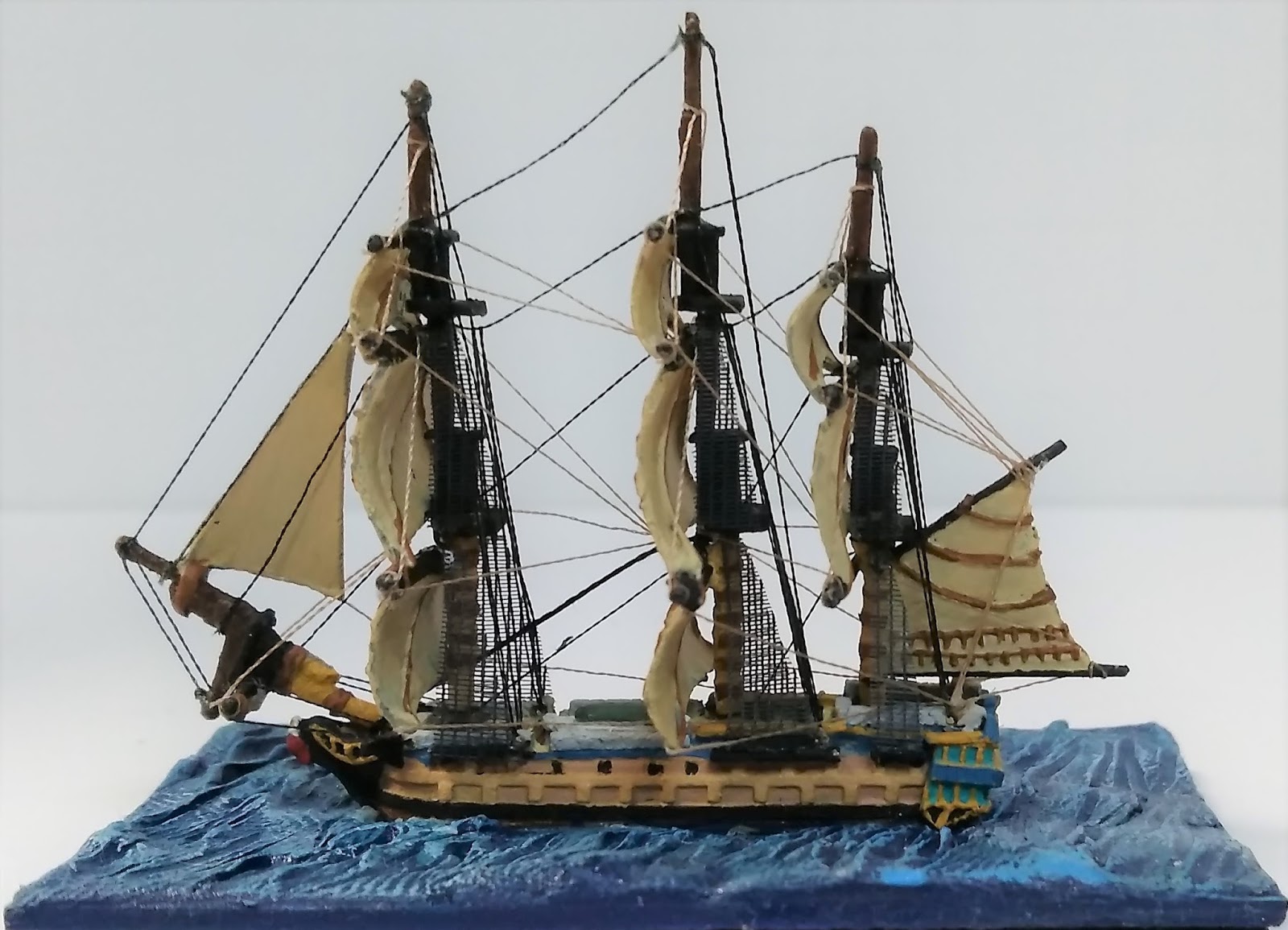
The obvious ships to start with are the First Rates.  Of course, one of them is HMS Victory.  I suspect there is a law somewhere that says every wargamer's British fleet has to have Nelson's flagship.  The other one is HMS Britannia, also a 100 gunner and a near-contemporary to Victory as to when she was constructed.  Victory was purchased, but I repainted the hull and did some rerigging when I rebased the ship.  If you want better close-ups of Britannia, they are located in my post entitled, "The Hundredth Ship" from September of 2017.  Given the number of ships in this post, I will be grouping them together in pictures as much as I can. 


Yes, the Victory is way too high out of the water.  That will be fixed the next time she
is rebased.  When is that?  Dunno.
Victory towing the boats was based on the Geoff Hunt painting "Victory races Temeraire
for the Enemy Line."  I added those to the ship when I rebased it the first time.
Next are that British anomaly, the Second Rates.  These are the 90-98 gunners.  According to Brian Lavery's book Nelson's Navy they were originally conceived in the 1670s as a cheaper alternative to the first rate.  By our time, they had no specific role and their shorter length compared to a first rate made them poor sailors so they were (according to Lavery) in decline as a class.  Be that as it may, there were 21 in the fleet in 1793, and 17 by 1812.  I have three 98s, and still have to pick up one more for Trafalgar.  I couldn't get all three into one shot, so each of these gets their own beauty shot.

First up is HMS Windsor Castle.  She was an active ship, seeing service at Toulon (1793), the Battle of Genoa (1795), Calder's Action (1805), the Action of 25 September (1806) and the Dardanelles (1807).  Unfortunately, it appears that Langton doesn't make this ship any more.

One of my early efforts, so in need of a little update now.
I did have a bit steadier hand back then.
  The next two ships are just generic 98s, both of which are "at quarters."  They are more time consuming to paint with all the guns run out, but you just can't beat the appearance.

This is one of my older bases that were built of wood and modelling clay.
You can clearly see here what I mean about having the guns run out.


This is a purchased ship.


Next up are the backbone of any fleet, the third rates.  Since I don't have any British 80 gunners, we'll start with 74s.  Officially, there were only 2 types of 74: Large and Common classes.  Gamers and the historian William James though, talk about 3 types: Large, Common and Middling.  The Middling 74 tends to be slightly longer than the Common (173-75 feet instead of 168-170 feet), and so could carry 2 more 18 pounder guns on the upper gun deck (30 instead of 28).  Large class 74s could carry 24 pounders on the upper gun deck, but didn't always do so.  The two ships below are my Large class 74s:

The ship on the left side of both photos is purchased.


Next are the 74 Middlings.  All three of these ships were purchased, but I had to reinstall the mizzenmast on the center one, so took that opportunity to repaint the hull.


The photos below are of my 74 Common class ships, which are the backbone of any British battleline, especially for the early battles.  At the beginning of 1793 there were 3 x Large 74's, 4 x Middling 74's and 54 x Common 74's in the fleet, although many of these were in ordinary.  By 1805 there were 24 x Large 74's, 11 x Middling 74's and 32 x Common 74's on the register, and a great many of them were in service.  So, no matter what year you're looking at, you need a lot of Common class 74 gunners.

All three of these are purchased.


The ship on the right in these photos is one of the first British 74's I built after I got back into Age of Sail gaming; maybe even the first.    One thing is for sure, though: I built it before I had a lot of my reference works, as the picture below will demonstrate:
See if you can spot the error.  It's REALLY easy.
Yes, that is a red painted gundeck.  No, apparently I didn't know any better almost 20 years ago.  Why don't I correct it?  Well, I think 1) it's a good reminder of how far I've come, and 2) no one has ever said anything about it.  To be honest, it's probably more the second reason since I'm kind of lazy in that regard.

The third rates wrap up with my 64 gun ships.  I have two of these, and a French 64 that often stands in when needed.  The French 64 was pictured in those fleet photos, so this will be just the two British ones.

Once again, the one on the left is purchased.

The right hand ship is HMS Agamemnon, which was featured in the
post entitled, "HMS Agamemnon; Nelson's Favorite..." back in July of 2017.

The last ship of the line type is another peculiarity of the British Navy and that's the Fourth Rate.  These are the 50 gun ships that had no place in the line of battle, or even fighting another ship of the line (see: https://en.wikipedia.org/wiki/HMS_Leander_(1780) ).  They were useful as squadron flagships in peacetime and as patrol vessels in wartime, which is why there were 19 in service in 1793, and 14 as late as 1812.

She's cute enough, but do the bigger ships pick on her when no one's looking?


Now that the ships of the line are out of the way, we come to the frigates.  There's not as many of them as there are ships of the line so they will each get their own beauty shot.  Just like the other ships, I will start with the largest and work my way down.

A purchased 40 gun frigate.


A 38 gunner, the backbone of the frigate fleet by 1813.


A purchased 36.  There were 43 of this type on the list in 1805.


Another 36.  This ship was the star of those "What Is My Time Worth" posts.


A purchased 32.  Most of my frigates are from a collection I bought when I
started AoS gaming again in 2000 or 2001.


A purchased 28 gun frigate.


To close out the post, here are a couple of ships that I suspect get no love at all from most gamers.  Those are the transports.  In real life, these were 44 gun two deckers like HMS Serapis that were converted for transport and troopship duties.  Although there were 21 of them in 1793, they were practically extinct by 1815.  If you want to run early war scenarios in places like the Caribbean though, you're going to need some.  I have two, and could need more depending on the scenario.

As you can see, this one still tries to look at least a little like a warship.


This one, however, isn't even trying anymore.


So there, at last, is my British fleet.  I think the next big post after this will be the various unrated warships that can be used for any side.  After that, future ships will show up as individual posts.  Once the Trafalgar project is finished, perhaps I will do a series of posts about each of the fleets involved for that, with pictures of all those ships together.