Showing posts with label third rates. Show all posts

Sunday, March 22, 2020

Climbed a mountain and I turned around . . . .

It's taken a little while to get this post up on the blog.  As my regular readers know, sometimes you just have to take a break from building sailing ships.  I have been putting ships on the Ironclads page, but apparently Blogger only tells people when I update the main page.  Oh, well . . . .

The title of the last post is a modification of the old sailor's song "Spanish Ladies."  Like I said, it's a slight modification as the original line went, "Farewell and adieu to you Spanish ladies."  I didn't think that fit too well into a post introducing two new Spanish ships, so I changed it.  Nonetheless, that song is the source for the title of the last post.  The song inspiration for this post is much newer, and probably won't be too hard for the readers to guess.

The two new ships in the post actually represent quite a milestone.  These are the last two ships needed to complete my Spanish Trafalgar fleet.  This is actually a bigger thing than you might think.  While I've been working on Spanish ships lately, this project has been (mostly) guiding my sailing ship building since about 2014 or so.  Consequently, I've worked on all three fleets, not just one.  There were 60 ships of the line at Trafalgar; right now I have 48 of them.  At this point, my fleet breakdowns are:
British: 19 of 27 SOL
French: 14 of 18 SOL
Spanish: 15 of 15 SOL.
I promise that there will be a post with all the Spanish Trafalgar ships together in the future.  

These two ships are from the 74/80 gun Montañes class.  According to Google Translate, the class name translates out as "Highlander," or "Mountain."  The first two ships (Montañes and Monarca) were built in 1794, the third (Neptuno) in 1795 and the last ship (Argonauta) was built in 1798.  They were well-designed ships, and Montañes was said to make 10 knots close-hauled and 14 knots running large in a fresh (force 5) wind.  All four ships served across the Spanish empire,with Montañes spending eight years in the Pacific and returning to Spain in 1803.  All four ships were at Trafalgar: Monarca and Neptuno were captured but sank in the storm that followed the battle.  Argonauta was also captured, but burned by the British after the battle.  Montañes  survived the battle but was out of service until February 1806 making repairs.  She remained in service until 1810, when she ran aground in Cadiz Bay during a storm.

So, with no further delay, here are the final two ships of my Spanish fleet at Trafalgar:


 And Now for the Brow Furrowing. . . .

As I mentioned in the last post, these models have some differences from the generic Spanish 74's that make me furrow my brow a bit.  As has been made clear on other forums, the Langtons say that their ships are generic types other than the named models, which do represent specific ships.  With that in mind, let's take a look at the deck plan of a Montañes class ship:

Taken from: https://www.todoababor.es/historia/como-es-por-dentro-un-navio-de-linea-de-74-canones-el-montanes/

For our purposes, there are three main areas of interest.  Those are the solid square on the poop deck (officer's cabins), the grates along the side of the waist opening, and the large square with four smaller ones in front of the waist.  This is the chimney for the ship's stove.  Below is a picture of my two ships before the masts were put in.


Hmmmmm.  Clearly the cabin on the poop is not solid, there are no grates around the waist, and that is definitely not a set of chimneys for the ship's stove just forward of the waist.  To me, these don't look like a Montañes class ship.  Now, let's take a look at NS3, the generic 74 gun Spanish ship of the line.


Well, now that's more like it!  We have the solid cabins on the poop, the grates along the waist AND the stove just forward of the waist.  There's even the curved rail behind the main mast.  Clearly the NS3/4 is the Montañes class of 74/80s, and I suspect that NS 21/22 would actually be the generic 74.  The stern piece in NS 21/22 is much closer to correct for the Montañes class ships than the stern piece for NS 3/4 would be.  The pictures below should make that quite clear.


So, what does this all mean?  In a perfect world, I guess I would rebuild my Spanish fleet using the correct hulls and sterns so that both types of 74 are correct.  😂😂😂 Yeah, like that's gonna happen!  I have spent too much time and money to throw all those ships out and start again.  Also, I've never had anyone at one of my games notice what I've discussed here.  Truth be told, I guess it only affects sticklers such as myself and Vol Williams. (You were right Vol, this is exactly what I was going to talk about!)  

Anyone expecting me to say anything bad about the Langtons can just surf off to another website right now.  Even with what I've described, I still prefer them over other brands.  GHQ ships are truly generic amazingly specific to the prototypes, as Vol and AdmiralHawke over at TMP have pointed out to me.  For example, the GHQ model of HMS Boyne actually has the appropriate figurehead for the ship!  What this means is that my bias against GHQ is based on two touchingly petty personal preferences: the GHQ ships feel too small,  and I don't care for their masts (I told you they were petty reasons 🙄) .  As for other brands, Navwar ships were rough when I started with them back in the 1980s and don't appear to have changed any.  Skytrex/Red Eagle ships are also unchanged from the 1980s, but they were better than Navwar back then.  When Rod Langton started his business, he really elevated the market for 1/1200 scale naval gaming miniatures.  Even with my nitpicking, I still think they're the best and I will keep building them.

Thursday, December 26, 2019

Hello to you, Spanish Ladies

Obviously, the title for the last post was a takeoff on the "Day-oh!" lyric from Harry Belafonte's famous Banana Boat Song.  For this post title though, I've gone a lot farther back than the 1950's.

This post is particularly exciting to me, as it means I am coming close to finishing part of the Trafalgar Project.  Now that these two are built,  I only need to finish two Montañes class ships of the line for  the Spanish fleet to be completed.  After those are done, I will wrap up the French fleet (4 ships to build) and then the British (8 left to build).

Like some of my other recent builds, there's not a lot to say about these ships.  Good old 74 gun ships of the line, the backbones of almost every fleet in the Age of Sail.  One ship of the two is "at quarters," so is a bit more bristly than its companion.  What really sets the two ships apart are their paint jobs, and I'll talk about that after the photos.


Like I said, the two ships are basically identical.  The ship at quarters is at fighting sail, but other than that and the upper stern decoration, they are the same.  In fact, their catalog numbers are NS3 and NS4.  What I find interesting is how much different they look due to the paint job.  The ship with the single yellow stripe appears to be smaller than the other one, even though this isn't so.  Given the side-by-side photos of these two paint schemes, it's easy to see how someone on another ship several miles away, looking through a telescope or the naked eye, might mistake the ship on the right of the photo as being all black.  I tried to take a picture from 15 feet away (3 scale miles), but my current phone camera isn't up to the task, unfortunately.

The single-striper will stand in for the San Justo, as I think she was one of the ships mentioned as being "black" by some British observers.  I remember reading it somewhere, but can't find the source now.  There is, however, a model at the Greenwich museum that support the idea that she was all black.  It comes from a diorama of the battle that was originally built in the 1840's.  The diorama was disassembled in 1978 and all that is left are the model ships.  The models are not on display in the museum, but there are pictures of them on the museum website.  This is the San Justo:

You can find this photo online at: https://collections.rmg.co.uk/collections/objects/539417.html
This was not a standard paint job for the models, as this photo of San Ildefonso shows:

This photo is located at: https://collections.rmg.co.uk/collections/objects/539239.html
Pictures of the diorama taken before its disassembly are at: https://collections.rmg.co.uk/collections/objects/68704.html .  Overall, I'm pretty confident that the paint scheme on my San Justo will pass inspection.

This is the last post for 2019.  When I post the finished Montañes ships we will be in a new decade!  In that post, I'll point out some interesting differences between those ships and these.  Those differences are a cause of some brow furrowing for me where Langton miniatures are concerned.  What is it, you ask?  Well, I will only drop you a hint by saying that Vol Williams already knows what I'm going to talk about. 🤔  Tune in next time!

Friday, September 13, 2019

Another Brick in the (Wooden) Wall

The title for the previous post is from the song "Workin' for a Livin'" by Huey Lewis and the News.  After I made the post, I looked the song up and discovered it was primarily a US hit instead of an international one.  So, apologies to any international readers I shortchanged.  Consequently, the musical reference in this title is so easy, I wouldn't even bother to give out a hint (well, if I gave out hints, which I haven't yet).  Let's just presume everyone got it, and move on.  Of course, for that one person who doesn't know the tune this title is riffing on, I will name it at the beginning of the next post. 😣

For the ship itself, there's not a lot to say really.  She's another British 74, of the Middling persuasion.  That means she measures between 173-175 feet on the gundeck, and normally carries 28 18-pounders on her upper gundeck.  This miniature will be representing one of the five Middling class vessels at Trafalgar.  I decided to paint her as a ship that is fresh out of the dockyard: whitish sails, no additional coloring or decoration other than stock.  My thought here is that perhaps her commander doesn't have a lot of extra money to spend on flashy decorations.  So, much like Captain Hardy in Victory, our fictional captain here took what he was given.


I haven't posted a picture with the Quarter of Comparison (TM) in a while.
The next few sailing ships up on the blog are going to be Spanish ones.  I recently made an order from Waterloo Minis (http://waterloominis.com/) that will allow me to finish my Spanish fleet for the Trafalgar Project.  If you're in the US or Canada and need to buy Langton miniatures, Waterloo is definitely the place.  Jeff is a great guy to deal with; if he has it in stock you'll get it, and if he doesn't he will let you know.  I trust him enough that when I order masts and sails, I'll tell him "I don't want X or Y, but any other setting is fine."  Given how finicky I am about my ships, that is high praise indeed!

Sunday, June 16, 2019

Back In the Saddle Again

While looking through my computer, I realized that I have not worked on a sailing ship since October of 2018.  For a blog about sailing ships, that is clearly too long!  I also realized that my Trafalgar project has gone even longer without any progress.  The obvious thing to do then, is to finish another ship of the line that will let me make progress on both general construction AND my Trafalgar goal.

Fortunately, I have a British 74 Common hull that has been painted since, well, October of 2018 or thereabouts.  When I order hulls, I always order sail sets to go along with them so all the ship needed was to have the masts and sails painted and installed, rig the ship, and just like that she's done.  Yep, that's the plan all right.

The masts and sails went together quickly enough, and I decided to experiment with how I paint my sails.  This time, I went with a black basecoat, linen first coat, tan drybrushing and then a drybrushing of linen again.  Overall, they seem a bit whiter than I normally like, but I can justify that by saying that she recently broke out a new set of canvas.  I've finally found the right size drill bit for enlarging the mast holes in the hull (a #52 bit, which is roughly 1.6 mm or .0635 inches).  This lets the mast fit with only a little bit of sanding using 1200 grit sandpaper.  With everything glued together, it was time to work on rigging.

The standing rigging went quicker than I thought it would, given that I hadn't done any rigging for about 8 or 9 months.  From there I moved to running rigging, and things started to slow a bit.  Here, I was having more trouble getting things going.  I was having problem with weaving the running rigging in and out of the standing rigging for the first couple of steps.  After that though, things started moving along more quickly.  As I was starting on step 8 of the running rigging I was thinking to myself, "Hmmm, it's been a few months but I've still got it."  It was right about then that I dropped the ship.

Truth be told, it wasn't a long fall; just a few inches from my hands to the desk.  It was, however, a long enough fall to rip a string of filthy words out of my mouth.  Good thing I was home alone!  Just like in the past, the standing rigging did its job and made it easy to pull everything back into place.  Once I got everything straightened back up, THEN I saw the evidence that my standing rigging job wasn't as snazzy as I thought it was.  The mizzenmast stays were much too loose and saggy, and part of the mainmast stays were wrapped around other lines.  Aarrgh!!!!  And no, there are no pictures of this fiasco, for the obvious reasons.

There was clearly only one way to fix these problems, and that was to cut out the mizzen and main masts standing rigging to do them over.  That meant that I also had to cut out step 8 of the running rigging as well.  Before rerunning all that string, I first had to redrill the holes for rigging at the stern of the ship.  I normally use a .7 mm drill bit there, because of the several different lines that go through those holes.  Turns out, when I drilled the holes on this ship, I used a .5 mm drill bit instead.  No wonder I couldn't get all the running rigging to fit through there!

After all this repair work was done, the rest of the build went pretty quickly.  No really, it did; I guess I needed those mistakes to shake me out of my complacency.  So, with no further ado, here are some beauty shots of the newest addition to the fleet:


The masts are in line, but for some reason this photo makes them look unaligned.


Some of the standing rigging does look a little loose, but it shows up
more in the photo than in real life.


I SWEAR to you that those masts are aligned with each other!

This ship will represent either Swiftsure or Berwick in the French fleet for Trafalgar, as both those ships were British prizes in French service.  However, she is rigged as a standard British ship, as this will make her more useful in other scenarios.  Honestly, I have never had a player in one of my games comment on the differences in rigging, so it probably doesn't really matter.  Over the years though, I've built enough ships in the two different rigging styles that I'm not going to stop now. 🙄

Monday, October 1, 2018

Hail Caesar!

Once of the nice things about having a large collection of ships is that you can occasionally buy something for a specific scenario.  This post is about one of those specialty ships.

One of the scenarios that I like to run at conventions is the Battle of Cape Ortegal (https://en.wikipedia.org/wiki/Battle_of_Cape_Ortegal).  If you leave out the British frigates, it's a nice 4 ships per side game, and can be pretty straightforward where victory conditions are concerned.  The ships are also pretty straightforward; 1 British 80 and 3 74's versus 1 French 80 and 3 74's.  What makes the scenario unique is that the British 80-gunner isn't a French prize, as one might expect.  Instead, she is a one-off design known as HMS Caesar.

Launched in 1793, Caesar was about as big as you could build a wooden warship at the time.  She measured 181 feet on the gundeck, compared to 168 feet for a Common class 74 gun ship of the line.  At Caesar's size, designers had to worry about the hull deforming due to the mere length of the vessel, even without the added weight of armaments.  USS Constitution is almost as long, at 175 feet on the gundeck.  Her designer, Joshua Humphreys, included diagonal braces called "riders" inside the hull that help prevent the hull from distorting.

Overall, Caesar's career was active but not particularly spectacular.  She was ordered in 1783, laid down in 1786, and launched in 1793.  She saw combat in 1794, 1801, 1805 and 1809 before being being converted to a depot ship in 1814 and finally broken up in 1821.  While she seems young to be taken out of service (21 years) compared to others (HMS Victory was already 28 years old when Caesar was launched), the numbers are a little misleading.  Caesar spent only two years out of service during her lifetime (1803-1805) whereas Victory was laid up several times (1765-1778, 1787-1792, 1799-1803, 1806-1808, 1813-1823) .  It's not exactly a fair comparison, as First Rates like Victory was expected to be taken out of service when the need for them wasn't pressing.  Still, even if you don't count anything before 1799, Victory spent about half of Caesar's active life in ordinary.

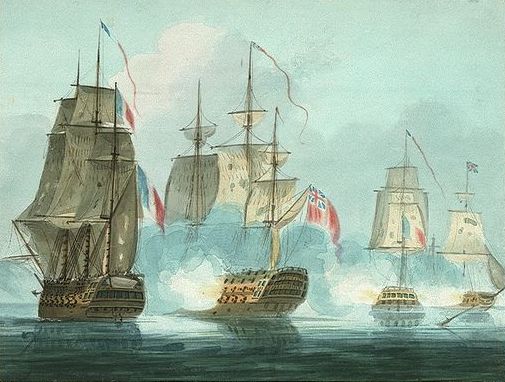
Given that she was active pretty continuously during the Napoleonic Wars, you'd think that there would be lots of paintings of her.  You'd also be wrong.  In searching for pictures to use as a painting guide, I found exactly two.  They are:
Listed as "Caesar engaging Mont Blanc"

"Strachan's Action After Trafalgar, Bringing Home the Prizes, HMS Caesar"


 Frankly, I don't think the top one is very helpful.  In the second one, the prize looks a lot like a three-decker and there weren't any of those at the engagement.  It does provide a good view of a British warship though, and the damage does correspond to what was reported for Caesar, which means that I am probably wrong on identifying the French ship.  So, I decided to go with this one.  Below are the pictures of my completed model.


Since there hasn't been a shot on here with the Quarter of Comparison in a while, I've also included one of those below.


To try and give you an idea of how much larger this ship is than other third rates, I've put some pictures of her with other British 74 gun ships of the line.  The first one has a British 74 Common class compared to Caesar.


74 Common on the left, Caesar on the right.  The difference between the white marks
is about 20-25 scale feet.
Next, a 74 Large class is compared to Caesar, and comes up short, albeit not as much.

74 Large on the left.  Remember that 1 millimeter in this scale is 4 feet.  That makes the difference
about 8 scale feet.  Not as short as the 74 Common, but still shorter than Caesar.
Finally, here's a shot of all three ships together.

L to R:  74 Common, 74 Large, HMS Caesar.
Just to be clear, the base is the same size (40 mm wide by 75 mm long) for all three ships.  Obviously, there's some variation as to just where I glue the ships on the bases!  That's why they are lined up by the blue lines on the stern.  The white lines mark where the ship's bow enters the water.

Sunday, March 25, 2018

The Indispensible Fleet.

At last, we have come to the fleet that you must have in a Age of Sail collection.  Yes, here is the British fleet.  No matter what other navy from this period you might have, at some point they fought against the British.  The Russian Navy that cooperated with the British (and Ottomans!) in 1798 would be blockaded in Lisbon by the British in 1808.  Sometimes, the British fought their enemies and allies at the same time.  As an example, see the Anglo-Russian War (1807-1812) and the Anglo-Swedish War (1810-1812).  No acts of war occurred between Great Britain and Sweden, trade continued between the two nations, AND the British navy kept using Swedish ports.  Nevertheless, the Swedes did declare war against their former allies.  Clearly then, if you are going to play French Revolution or Napoleonic AOS scenarios, then you need a British fleet.

With all that in mind, here is my British fleet.  Keep in mind that even with all these ships, it is still growing as I progress towards completing my Trafalgar project.  The future ships will be seen on the blog as they're completed of course.  Maybe in the future, I can revisit this post and get all of the family together in one place.

The obvious ships to start with are the First Rates.  Of course, one of them is HMS Victory.  I suspect there is a law somewhere that says every wargamer's British fleet has to have Nelson's flagship.  The other one is HMS Britannia, also a 100 gunner and a near-contemporary to Victory as to when she was constructed.  Victory was purchased, but I repainted the hull and did some rerigging when I rebased the ship.  If you want better close-ups of Britannia, they are located in my post entitled, "The Hundredth Ship" from September of 2017.  Given the number of ships in this post, I will be grouping them together in pictures as much as I can. 


Yes, the Victory is way too high out of the water.  That will be fixed the next time she
is rebased.  When is that?  Dunno.
Victory towing the boats was based on the Geoff Hunt painting "Victory races Temeraire
for the Enemy Line."  I added those to the ship when I rebased it the first time.
Next are that British anomaly, the Second Rates.  These are the 90-98 gunners.  According to Brian Lavery's book Nelson's Navy they were originally conceived in the 1670s as a cheaper alternative to the first rate.  By our time, they had no specific role and their shorter length compared to a first rate made them poor sailors so they were (according to Lavery) in decline as a class.  Be that as it may, there were 21 in the fleet in 1793, and 17 by 1812.  I have three 98s, and still have to pick up one more for Trafalgar.  I couldn't get all three into one shot, so each of these gets their own beauty shot.

First up is HMS Windsor Castle.  She was an active ship, seeing service at Toulon (1793), the Battle of Genoa (1795), Calder's Action (1805), the Action of 25 September (1806) and the Dardanelles (1807).  Unfortunately, it appears that Langton doesn't make this ship any more.

One of my early efforts, so in need of a little update now.
I did have a bit steadier hand back then.
  The next two ships are just generic 98s, both of which are "at quarters."  They are more time consuming to paint with all the guns run out, but you just can't beat the appearance.

This is one of my older bases that were built of wood and modelling clay.
You can clearly see here what I mean about having the guns run out.


This is a purchased ship.


Next up are the backbone of any fleet, the third rates.  Since I don't have any British 80 gunners, we'll start with 74s.  Officially, there were only 2 types of 74: Large and Common classes.  Gamers and the historian William James though, talk about 3 types: Large, Common and Middling.  The Middling 74 tends to be slightly longer than the Common (173-75 feet instead of 168-170 feet), and so could carry 2 more 18 pounder guns on the upper gun deck (30 instead of 28).  Large class 74s could carry 24 pounders on the upper gun deck, but didn't always do so.  The two ships below are my Large class 74s:

The ship on the left side of both photos is purchased.


Next are the 74 Middlings.  All three of these ships were purchased, but I had to reinstall the mizzenmast on the center one, so took that opportunity to repaint the hull.


The photos below are of my 74 Common class ships, which are the backbone of any British battleline, especially for the early battles.  At the beginning of 1793 there were 3 x Large 74's, 4 x Middling 74's and 54 x Common 74's in the fleet, although many of these were in ordinary.  By 1805 there were 24 x Large 74's, 11 x Middling 74's and 32 x Common 74's on the register, and a great many of them were in service.  So, no matter what year you're looking at, you need a lot of Common class 74 gunners.

All three of these are purchased.


The ship on the right in these photos is one of the first British 74's I built after I got back into Age of Sail gaming; maybe even the first.    One thing is for sure, though: I built it before I had a lot of my reference works, as the picture below will demonstrate:
See if you can spot the error.  It's REALLY easy.
Yes, that is a red painted gundeck.  No, apparently I didn't know any better almost 20 years ago.  Why don't I correct it?  Well, I think 1) it's a good reminder of how far I've come, and 2) no one has ever said anything about it.  To be honest, it's probably more the second reason since I'm kind of lazy in that regard.

The third rates wrap up with my 64 gun ships.  I have two of these, and a French 64 that often stands in when needed.  The French 64 was pictured in those fleet photos, so this will be just the two British ones.

Once again, the one on the left is purchased.

The right hand ship is HMS Agamemnon, which was featured in the
post entitled, "HMS Agamemnon; Nelson's Favorite..." back in July of 2017.

The last ship of the line type is another peculiarity of the British Navy and that's the Fourth Rate.  These are the 50 gun ships that had no place in the line of battle, or even fighting another ship of the line (see: https://en.wikipedia.org/wiki/HMS_Leander_(1780) ).  They were useful as squadron flagships in peacetime and as patrol vessels in wartime, which is why there were 19 in service in 1793, and 14 as late as 1812.

She's cute enough, but do the bigger ships pick on her when no one's looking?


Now that the ships of the line are out of the way, we come to the frigates.  There's not as many of them as there are ships of the line so they will each get their own beauty shot.  Just like the other ships, I will start with the largest and work my way down.

A purchased 40 gun frigate.


A 38 gunner, the backbone of the frigate fleet by 1813.


A purchased 36.  There were 43 of this type on the list in 1805.


Another 36.  This ship was the star of those "What Is My Time Worth" posts.


A purchased 32.  Most of my frigates are from a collection I bought when I
started AoS gaming again in 2000 or 2001.


A purchased 28 gun frigate.


To close out the post, here are a couple of ships that I suspect get no love at all from most gamers.  Those are the transports.  In real life, these were 44 gun two deckers like HMS Serapis that were converted for transport and troopship duties.  Although there were 21 of them in 1793, they were practically extinct by 1815.  If you want to run early war scenarios in places like the Caribbean though, you're going to need some.  I have two, and could need more depending on the scenario.

As you can see, this one still tries to look at least a little like a warship.


This one, however, isn't even trying anymore.


So there, at last, is my British fleet.  I think the next big post after this will be the various unrated warships that can be used for any side.  After that, future ships will show up as individual posts.  Once the Trafalgar project is finished, perhaps I will do a series of posts about each of the fleets involved for that, with pictures of all those ships together.