Showing posts with label fourth rate. Show all posts

Thursday, December 2, 2021

Saturn

The original plan was for this post to go up before Thanksgiving. Just a short update, and a promise of better future performance in the making posts department. Obviously, that didn't come to fruition.  So, I hope that all my readers who celebrate the Thanksgiving holiday had a nice one.

The shipyard has been fairly busy as we get towards the end of the year, as you can see from the photo below:


The partially-rigged French 80 and the British 74 Common hull represent the final two ships of the line for the Combined Fleet.    Yes!  Just two more ships, and the Trafalgar Project is 2/3rds complete.  You can expect a big "family photo" of all those in an upcoming post at some point.  Now as mentioned in another post, I don't have the all the frigates for the Combined Fleet yet, but those can be picked up at leisure once the battle line is done.  

I'm sorry, what's that?  Why yes, you're right, there ARE three sailing ships in that photo.  Very observant of you.  That third ship is HMS Saturn, and she has a rather interesting history.

HMS Saturn was a member of the Arrogant-class ships of the line.  Designed by Sir Thomas Slade (who also designed HMS Victory), there were twelve ships built to this design, the most famous of which was HMS Bellerophon.  Bellerophon fought in the Glorious First of June, the Nile, Trafalgar, AND was the ship that Napoleon boarded to surrender himself the first time.  A development from the 5 ship Bellona-class vessels, Saturn and her sisters were the epitome of the British 74-gun ship of the line.  

The Arrogant class ships, as built.

Ordered in December of 1781, Saturn was laid down in August of 1782, launched in November of 1786 and finally completed in May of 1787.  After completion, she sat in ordinary (the modern term is "mothballed") until May of 1790.  During the French Revolutionary Wars, she served in the Channel Fleet and the Mediterranean, where she was involved in the Battle of the Hyères Islands in 1795. [https://en.wikipedia.org/wiki/Battle_of_the_Hyères_Islands]  Her other major action was at the Battle of Copenhagen in 1801, but she was in the reserve and did not see action.  Her service after that was pretty typical: West Indies, the Med again, blockade duty off Lorient, then back to the Baltic.  In 1812 she was in ordinary again, and the 25 year old warrior faced a dismal future of either being broken up or used as a prison ship.  

Then the War of 1812 happened.  Everyone knows about the US frigate victories, and the Royal Navy orders not to engage American frigates in single combat.  Less well known, however, is the other British response to the defeats: the decision to acquire their own super frigates.  Instead of building new ships though, the Royal Navy took a more direct approach.  HMS Saturn and two other 74-gun ships (Majestic (1785) and Goliath (1781)) were cut down from ships of the line into frigates.  For these ships, it was done by cutting away the upper decks.  This process was known as razeéing from the French rasé meaning "to shave" so the ships were referred to as razeés. Instead of looking like the blueprint above, they now look like this:

HMS Saturn after conversion to a frigate

The thing to notice here is that the ship has kept her two original gun decks; only the upperworks containing lighter weapons has been taken away.  The guns do get changed around a bit though.  As built, Saturn carried 28 32 pounders on the lower gundeck, and 28 18 pounders on the upper deck.  After reconstruction, she carried 28 32 pounders on the lower gundeck, and 28 42 pound carronades on the upper deck.  This change increased her weight of metal (the amount thrown in a single broadside)
from 952 to 1,036 pounds.  For comparison, the weight of metal for her intended opponents ranged from 712 to 864 pounds and even HMS Victory only threw 1,220 pounds per broadside.

As it happened, the British razeés never did go head-to-head against their intended opponents.  Majestic did fire a few shots at USS President during her pursuit and capture, but fell behind when the wind strength dropped.  Apparently all three of the razeés were good sailors, but only in a heavy wind.  Saturn spent her time blockading New York, and after the war was put back into ordinary in April of 1815.  As I said in the previous post about USS Franklin/Independence though,  these sorts of what-if scenarios are why we play naval wargames!  If you're going to stretch history enough to let USS Independence out of port with Constitution, then it's no larger a stretch to move HMS Saturn from the New York blockade to the Boston one.  All this rationalization is just another way of saying that I built a model of Saturn so she could be put up against the US Navy, just as her designers intended.

In building my Saturn, I decided to go with the very late war black/white paint scheme for her.  It made sense to me; after all, in this incarnation she is only active from 1813-1815.  Also, I found a drawing of Majestic in that scheme, and it sealed the deal for me.  After all, with one paint scheme she could represent two ships.


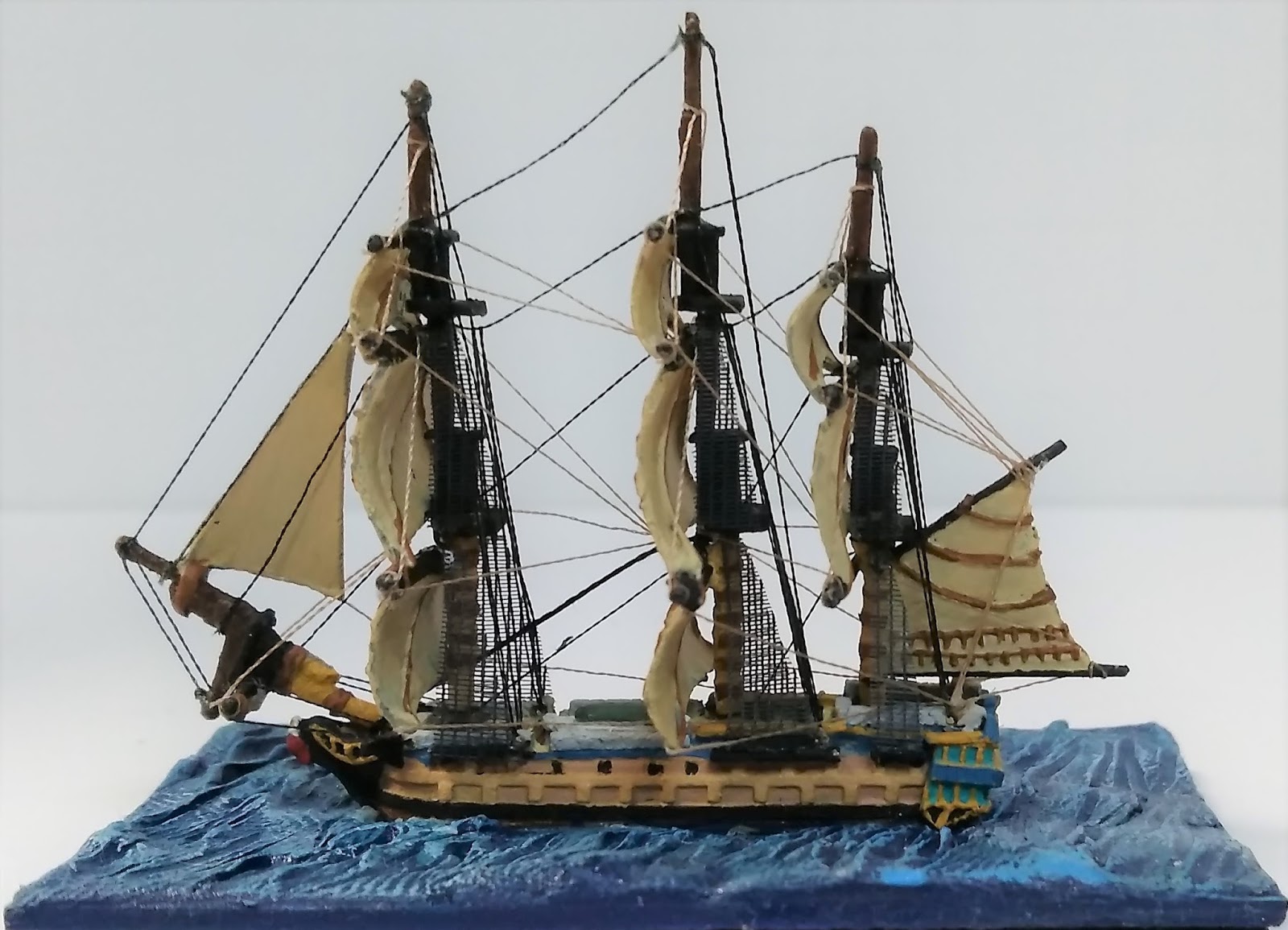
And, with no further ado, here is my version of these ships:


To me, she is not a pretty miniature.  In fairness though, if you look at the above plan she doesn't appear to be a very pretty ship after the conversion.  And, it's pretty obvious that the miniature was designed right off the original plan.  At first, it looks to me as if her lower guns are WAY too far above the water.  After taking some measurements from the plans though, I think that my assumption about that was wrong.  

Unlike many of my ships, her first taste of action will come this weekend.  I am running the hypothetical breakout scenario mentioned above at our local convention held on the Battleship Texas this Saturday afternoon.  Expect pictures and a game report in the near future!

Oh, and the title of this post is not just a recitation of the ship's name.  The song "Saturn" comes from the 1976 album Songs in the Key of Life by Stevie Wonder.  Yes, the same album that had the hits "Sir Duke" and "Isn't She Lovely."  Yes, it IS hard to believe it was that long ago.  You can check "Saturn" out on YouTube:  https://www.youtube.com/watch?v=p3KpUO6t9qQ


Sunday, March 25, 2018

The Indispensible Fleet.

At last, we have come to the fleet that you must have in a Age of Sail collection.  Yes, here is the British fleet.  No matter what other navy from this period you might have, at some point they fought against the British.  The Russian Navy that cooperated with the British (and Ottomans!) in 1798 would be blockaded in Lisbon by the British in 1808.  Sometimes, the British fought their enemies and allies at the same time.  As an example, see the Anglo-Russian War (1807-1812) and the Anglo-Swedish War (1810-1812).  No acts of war occurred between Great Britain and Sweden, trade continued between the two nations, AND the British navy kept using Swedish ports.  Nevertheless, the Swedes did declare war against their former allies.  Clearly then, if you are going to play French Revolution or Napoleonic AOS scenarios, then you need a British fleet.

With all that in mind, here is my British fleet.  Keep in mind that even with all these ships, it is still growing as I progress towards completing my Trafalgar project.  The future ships will be seen on the blog as they're completed of course.  Maybe in the future, I can revisit this post and get all of the family together in one place.

The obvious ships to start with are the First Rates.  Of course, one of them is HMS Victory.  I suspect there is a law somewhere that says every wargamer's British fleet has to have Nelson's flagship.  The other one is HMS Britannia, also a 100 gunner and a near-contemporary to Victory as to when she was constructed.  Victory was purchased, but I repainted the hull and did some rerigging when I rebased the ship.  If you want better close-ups of Britannia, they are located in my post entitled, "The Hundredth Ship" from September of 2017.  Given the number of ships in this post, I will be grouping them together in pictures as much as I can. 


Yes, the Victory is way too high out of the water.  That will be fixed the next time she
is rebased.  When is that?  Dunno.
Victory towing the boats was based on the Geoff Hunt painting "Victory races Temeraire
for the Enemy Line."  I added those to the ship when I rebased it the first time.
Next are that British anomaly, the Second Rates.  These are the 90-98 gunners.  According to Brian Lavery's book Nelson's Navy they were originally conceived in the 1670s as a cheaper alternative to the first rate.  By our time, they had no specific role and their shorter length compared to a first rate made them poor sailors so they were (according to Lavery) in decline as a class.  Be that as it may, there were 21 in the fleet in 1793, and 17 by 1812.  I have three 98s, and still have to pick up one more for Trafalgar.  I couldn't get all three into one shot, so each of these gets their own beauty shot.

First up is HMS Windsor Castle.  She was an active ship, seeing service at Toulon (1793), the Battle of Genoa (1795), Calder's Action (1805), the Action of 25 September (1806) and the Dardanelles (1807).  Unfortunately, it appears that Langton doesn't make this ship any more.

One of my early efforts, so in need of a little update now.
I did have a bit steadier hand back then.
  The next two ships are just generic 98s, both of which are "at quarters."  They are more time consuming to paint with all the guns run out, but you just can't beat the appearance.

This is one of my older bases that were built of wood and modelling clay.
You can clearly see here what I mean about having the guns run out.


This is a purchased ship.


Next up are the backbone of any fleet, the third rates.  Since I don't have any British 80 gunners, we'll start with 74s.  Officially, there were only 2 types of 74: Large and Common classes.  Gamers and the historian William James though, talk about 3 types: Large, Common and Middling.  The Middling 74 tends to be slightly longer than the Common (173-75 feet instead of 168-170 feet), and so could carry 2 more 18 pounder guns on the upper gun deck (30 instead of 28).  Large class 74s could carry 24 pounders on the upper gun deck, but didn't always do so.  The two ships below are my Large class 74s:

The ship on the left side of both photos is purchased.


Next are the 74 Middlings.  All three of these ships were purchased, but I had to reinstall the mizzenmast on the center one, so took that opportunity to repaint the hull.


The photos below are of my 74 Common class ships, which are the backbone of any British battleline, especially for the early battles.  At the beginning of 1793 there were 3 x Large 74's, 4 x Middling 74's and 54 x Common 74's in the fleet, although many of these were in ordinary.  By 1805 there were 24 x Large 74's, 11 x Middling 74's and 32 x Common 74's on the register, and a great many of them were in service.  So, no matter what year you're looking at, you need a lot of Common class 74 gunners.

All three of these are purchased.


The ship on the right in these photos is one of the first British 74's I built after I got back into Age of Sail gaming; maybe even the first.    One thing is for sure, though: I built it before I had a lot of my reference works, as the picture below will demonstrate:
See if you can spot the error.  It's REALLY easy.
Yes, that is a red painted gundeck.  No, apparently I didn't know any better almost 20 years ago.  Why don't I correct it?  Well, I think 1) it's a good reminder of how far I've come, and 2) no one has ever said anything about it.  To be honest, it's probably more the second reason since I'm kind of lazy in that regard.

The third rates wrap up with my 64 gun ships.  I have two of these, and a French 64 that often stands in when needed.  The French 64 was pictured in those fleet photos, so this will be just the two British ones.

Once again, the one on the left is purchased.

The right hand ship is HMS Agamemnon, which was featured in the
post entitled, "HMS Agamemnon; Nelson's Favorite..." back in July of 2017.

The last ship of the line type is another peculiarity of the British Navy and that's the Fourth Rate.  These are the 50 gun ships that had no place in the line of battle, or even fighting another ship of the line (see: https://en.wikipedia.org/wiki/HMS_Leander_(1780) ).  They were useful as squadron flagships in peacetime and as patrol vessels in wartime, which is why there were 19 in service in 1793, and 14 as late as 1812.

She's cute enough, but do the bigger ships pick on her when no one's looking?


Now that the ships of the line are out of the way, we come to the frigates.  There's not as many of them as there are ships of the line so they will each get their own beauty shot.  Just like the other ships, I will start with the largest and work my way down.

A purchased 40 gun frigate.


A 38 gunner, the backbone of the frigate fleet by 1813.


A purchased 36.  There were 43 of this type on the list in 1805.


Another 36.  This ship was the star of those "What Is My Time Worth" posts.


A purchased 32.  Most of my frigates are from a collection I bought when I
started AoS gaming again in 2000 or 2001.


A purchased 28 gun frigate.


To close out the post, here are a couple of ships that I suspect get no love at all from most gamers.  Those are the transports.  In real life, these were 44 gun two deckers like HMS Serapis that were converted for transport and troopship duties.  Although there were 21 of them in 1793, they were practically extinct by 1815.  If you want to run early war scenarios in places like the Caribbean though, you're going to need some.  I have two, and could need more depending on the scenario.

As you can see, this one still tries to look at least a little like a warship.


This one, however, isn't even trying anymore.


So there, at last, is my British fleet.  I think the next big post after this will be the various unrated warships that can be used for any side.  After that, future ships will show up as individual posts.  Once the Trafalgar project is finished, perhaps I will do a series of posts about each of the fleets involved for that, with pictures of all those ships together.