Showing posts with label Russian. Show all posts

Thursday, April 29, 2021

Mister Mojo Risin' . . .

 It's amazing what a little time away can do for one's creativity.  I didn't touch a sailing ship from March 17, 2020 to December 15, 2020.  Then, from 12/15/2020 to the time of this post, I completed X of them.  That's how I thought this post was going to go.

Instead, it has become a story about how your mojo can vanish and return.  I was working quickly and had 4 ships under construction, with 3 of them either ready to be, or in the process of being rigged.  Then, I walked in one morning and found a scene of partial despair.  Turns out that our 16-year-old cat had decided to hop up on my painting table during the night.  She hasn't done that in years, so why now?  No idea. 🤬 cat. . . . 

Of course, the most complete ship was the one that took the worst damage.  The Russian 46 gun ship had all the standing rigging and most of the running rigging done.  This turned out to be a good thing, as while the masts were all knocked askew, I was able to pull them back into line using the standing rigging.  The brass ratlines didn't come out anywhere near as well, though.  I wound up having to replace 3 of them, which meant I had to order a new set (they aren't something that I keep an excess stock of lying around).  


Starboard lower mainmast, starboard and port lower mizzen
ratlines. Clearly after being cat-ified.

The other two ships weren't as badly damaged, since they were sheltered behind the Russian.  Only one ratline went missing from them, and that was my fault.  I went to glue it back in place, dropped it, heard it hit the tile floor. . . and it vanished.  So, time to order TWO spare ratline sets.

Once those arrived, I was ready to get started again.  Then, the hospital called.  I've been needing some kidney surgery for a while but it had been delayed several times by COVID.  Now, they were ready for me on the 14th of April.  I'll spare you the gory details, since 1) nobody wants to hear them, and 2) I don't know any of them; I was unconscious for the bloody, cutting parts.  After an overnight stay for observation, I went home the next afternoon.  Oddly enough, the experience left me in NO mood to do any hobby type work.  Who could have guessed? 🤷‍♂️  Also, I realized that operating knives, scissors and glue might not be a good idea while under the influence of painkillers.  After all that drama, I was finally able to get back to work and get the three ships ready for their debut here on the blog.

Now, to be fair, they weren't all done from scratch.  Instead, along with working on my Trafalgar project, I decided to do some more unicorn hunting.  It's one thing for me to say that I finally finished up my Russian 46 gun frigate.  It's another thing altogether when I tell you that ship has been "under construction" since September of 2014!  In that time, the overall collection has gone from 86 ships total to 114 as of April 24.  So, even though he (Russians call their ships "he," not "she") was not the first one finished in this group, mere seniority gives him the first spot in this post.

Yes, I know the headsails are missing. That will be corrected.


The Quarter of Comparison hasn't made an appearance
in a while, so there it is.

Now, this is not his first appearance on the blog.  Back in January 2018 this ship was featured in a post called "Unicorn Hunting" (https://mymodelsailingships.blogspot.com/2018/01/unicorn-hunting.html).  I ended that post with the quote, "However, no matter what their future careers may take them, I'm determined to cut down on the size of the unicorn fleet."  So, just three short years later, here we are! 🙄


Remember, this is how the ship first appeared 
on the blog.

Eagle-eyed readers will notice that this ship isn't painted in the usual black/white scheme associated with Russian and American ships for this period.  There is, of course, a reason for that.  As I said in the earlier post, the Russian Navy didn't start painting their ships black and white until about 1802.  One of two of the 46 gun ships might have been around then, but they were all retired by the time the Russo/Ottoman War of 1806 broke out.  So, this ship gets an earlier style scheme.

Next up is a French 74.  She only had a furled sail knocked off during the Great Cat-astrophe (you know the puns here are bad; too late to complain now) so was easy to fix.  Truth be told, I got a little lazy with this ship.  The hull and masts are the same shade of yellow.  I doubt that they were ever this exact a match.  According to Boudriot's The 74-Gun Ship, French lower masts were usually black in home waters, and white in the tropics.  His information is for the the-Revolution navy of 1780.  I suspect the regulations stayed much the same, but the disorder of the Revolution made them much harder to obey.  Well, that's my justification for it anyway.


The last ship of the three is a Spanish 74.  As mentioned in an earlier post, my Spanish navy for Trafalgar is complete.  Instead, she will take the part of Intrepide in the French fleet, as that was a Spanish ship in French service.  I decided to try a slightly different shade of yellow for this ship's hull, and it was successful but not in the way I thought.  Instead of a weathered yellow, what I got was a look that I think is very similar to the varnished sides of the 1770s and earlier.  I don't think it dates the ship too terribly, and it is a different look than unending variations on yellow.


At this point, there are two ships left to do (an 80, and a British 74 Common) and the Combined Fleet will be complete.  That, to be honest, is an odd feeling.  I will still need to build some frigates for them, but all of the ships of the line will be done.  After that, just eight more British ships of the line will complete that fleet.  I owe the British one frigate, instead of the three for the French.  Still, the end is in sight at last!

For sticking this out until the end, here's some bonus content.  At the beginning of the post, I said there were four ships under construction.  Well, here's a sneak peek at number 4:


She's the USS Franklin, one of the 74s that the US Navy launched at the end of the War of 1812.  She's called a 74, but was actually pierced for 87 guns (DANFS says 63 x32 pounder long guns and 24 x 32 LB carronades).  You can do a plausible "what-if" breakout style scenario for her and a companion, but it's more likely that she'll spend most of her life under another flag as needed.

Finally, after reading my gripes about the cat, it seems that she deserves a picture here too.  So, without further ado:

The breaker of ships.


Tuesday, October 22, 2019

Yes I Am (almost) A Pirate, Part II

So after lunch on Friday, I ran my second game of the day.  This time, it was a much more modern game of Save the Whale.  Anyone who has read the blog regularly has seen those models being painted up; now, it was time for them to be used. 

One thing that I think is important for players of the game (and readers of the blog) to understand is that it is NOT a “serious game.”  I mean, the object for one side is to kill a whale, for goodness sakes!  Instead, the game is much more fun when both sides fulfill the stereotypes that are expected of them.  Fortunately, I had a group of players that were more than ready to embrace said stereotypes.  The whalers not only wanted to harpoon a whale; they were bound and determined to do as much damage to the Greenpeace ships as possible.  My Greenpeace players were equally hardcore:  At the beginning of the game one of them said, “We don’t care about casualties and damage.  We ONLY. WANT TO. SAVE. WHALES!”  With that, I knew we were going to have a rollicking game, and we did.

There are no setup rules per se, so we just rolled random locations for everybody (including the whale) and got started.  For whatever reason, there aren’t as many pictures of this scenario as there are of the earlier one.  I didn’t even start taking pictures until several turns into the game, so this time they are going to be of more interesting moments in the game.  The Greenpeace rubber boats rapidly headed towards the factory ship, which decided to use fire hoses to keep them away.  I explained to the factory ship captain that this would give his side negative publicity points, but to his credit he didn’t care.

Damn the publicity, fire hoses away!
He was successful too.  The die next to the boat means that it can’t move for the next 4 turns.  At the same time, Solo decided to get into the action and turned their hoses on one of the harpoon boats:


"Well, if they can do it. . . "


The brown thing behind Solo is a mooring line.  Ships can drag those behind them to try and foul their opponent’s propellers, but if they roll a 1 on a D6 the line breaks and is lost.  This mooring line is probably in the Greenpeace museum, as the player kept it for the entire game, even after fouling one ship.  The harpoon ship Solo snared was  so badly fouled that with other damage it was down to only one knot of speed.  The players agreed to give him some speed back, as he was out of play otherwise.  He also tried to foul the factory ship but was unsuccessful.

"Somebody's getting a taste of this rope.  Oh, guess it's you."
The one rubber boat swamped by the factory ship wound up not mattering much, as the rest of them swarmed the factory ship and got out the spray paint.  Both of them passed their die rolls, although not on the same turn, and applied slogans to the side of the factory ship.  Fortunately for the whalers, only two slogans counted for publicity points, and the boats ran off to interfere with the harpoon ships after that.

Like fleas on a dog. . . .

"The different colors of paint make it ART, not GRAFFITI!"
The  captain of the factory ship decided to use his ship as a sort of mobile battering ram, trying to force a collision with any Greenpeace vessel he could get close to.  He was remarkably successful in this, giving damage to both protest ships and reducing Rainbow Warrior to no speed by the end of the game. 
Despite all their aggression (and attendant negative publicity) the whalers did not succeed in killing a whale, so the protesters won this game.  Given the laughter around the table for the great majority of the game, I’m going to assume that everyone had a good time.  That ended Friday for me.

On Saturday, I had a chance to play some games, so I took advantage of that.  The first one was a game called Conn, Sonar!  This is a beer and pretzels modern submarine game, and the scenario was the final battle from Hunt for Red October.  Yours truly got to drive the Alfa class sub looking to kill Red October.
1/700 scale subs are oversize, but sure look good.
 The core mechanic of the game is getting a fire control solution on your target.  Every time you are successful using passive or active sonar, you get a solution counter for your target.  Once you have three, you can fire.  You can also try to take back your markers from others by being quiet.  I had an intermittent solution on the US sub, but could get nothing on Red October, as her commander kept extra quiet by using the caterpillar drive.  Fortunately, the Dallas couldn’t fire until he was fired on.
Once I realized that I couldn’t find Red October by being stealthy, I filled the water with active sonar waves.  I finally got a solution and fired two torpedoes before I lost him again.

Things are starting to get a bit crowded.
This is where things REALLY got interesting!  Of my two torps, one did not acquire, and began a circle to the right.  The other acquired Red October but missed her.  Going past the ship, it acquired and began to track Dallas.  That fulfilled her Rules of Engagement, so now she could start shooting back.

"Sorry about accidentally starting WWIII, guys." 

My first torpedo then acquired ME, so I decided it was time to leave the area at full speed.  Dallas turned in front of Red October and fired two torpedoes that had no trouble acquiring me, given the noise I was putting out at 40+ knots.  However, my second torpedo switched from the US sub to the larger target and hit Red October.  Good news for me!  However, a target that large requires two hits to be destroyed.  Bad news for me!

"So, do you want the good news, or the bad news?"

After a turn or so of running like mad, this is my situation:


"Looks like we made someone mad."
As my quarry was only damaged, I decided to try and get out of the torpedo’s seeker heads, and head back towards the (now damaged) missile sub.  They turned tighter than me though, so I wound up taking two USN Mk-48 torpedoes in the side and one was enough to kill me.  Game over.  Being a movie game, the movie quotes were flying around throughout the game.  Among them:

“We’re going to kill a friend, Vasily.”
“Set safeties to zero.”
“You fool, you’ve killed US,” and finally
“You mean you have TWO subs missing in the North Atlantic?”

Overall, they’re a fun set of rules that let us play a game of 19 turns to conclusion in under 2 to 2 1/2 hours, which included explaining the rules.  It manages to capture the feel of submarine combat, or at least what we think it’s supposed to feel like 🤔.

The last game of the day was Check Your 6! Jet Age.  This was another movie game and was actually two scenarios in one session.  To teach everyone the basic movement and combat rules, we did a scenario from the movie Top Gun of students versus instructors.  So, it was F-14's against A-4 Skyhawks with guns but no missiles.  After everyone understood the rules, we reset the game.  This time though, it was the final battle from Top Gun.  You know the one:  “Somewhere in the Indian Ocean.  Present day.”  And yes, we even had the dreaded MiG-28's.  They have missiles and afterburners, so are a much more even fight for the Americans.  The picture below is just after the merge:

Yes, there's an F-18 in the game.  Didn't bother the players, so don't
let it bother you.
THIS time though, the forces of Somewhereastan got their teeth into the Americans invading their airspace.

That is a dead Tomcat.  Note that there's no parachutes, either.
We played a few more turns, but weren't able to complete the game, as we were running out of time.  The end of the game looked like this:

Note that the other Tomcat is smoking.  Black smoke indicates engine damage
and orange indicates afterburner use.
With one F-14 shot down and another damaged, the forces of the People's Democratic Republic of Somewhereastan immediately declared victory.  The funny thing in this game were not the movie quotes (although there were a few), but this:

Remember me?

Yes, the Broadside! token that I mentioned in the first post.  Apparently it is the official currency of Somewhereastan, as over 20 of them were used during the game with the great majority being played by the Commie pilots.  I think at one point we were accused of flying this mission straight from the strip club, due to all the tokens we used!  The money used to purchase them goes to the Battleship Texas though, so it's worth it.  After this game slot, we had our convention speaker and then retired to the traditional after convention dinner.  There were other games played during the two days, but I didn't get any pictures of them.  Whether this is due to being busy, or being lazy, I will leave up to the readers to decide.

Sunday, October 28, 2018

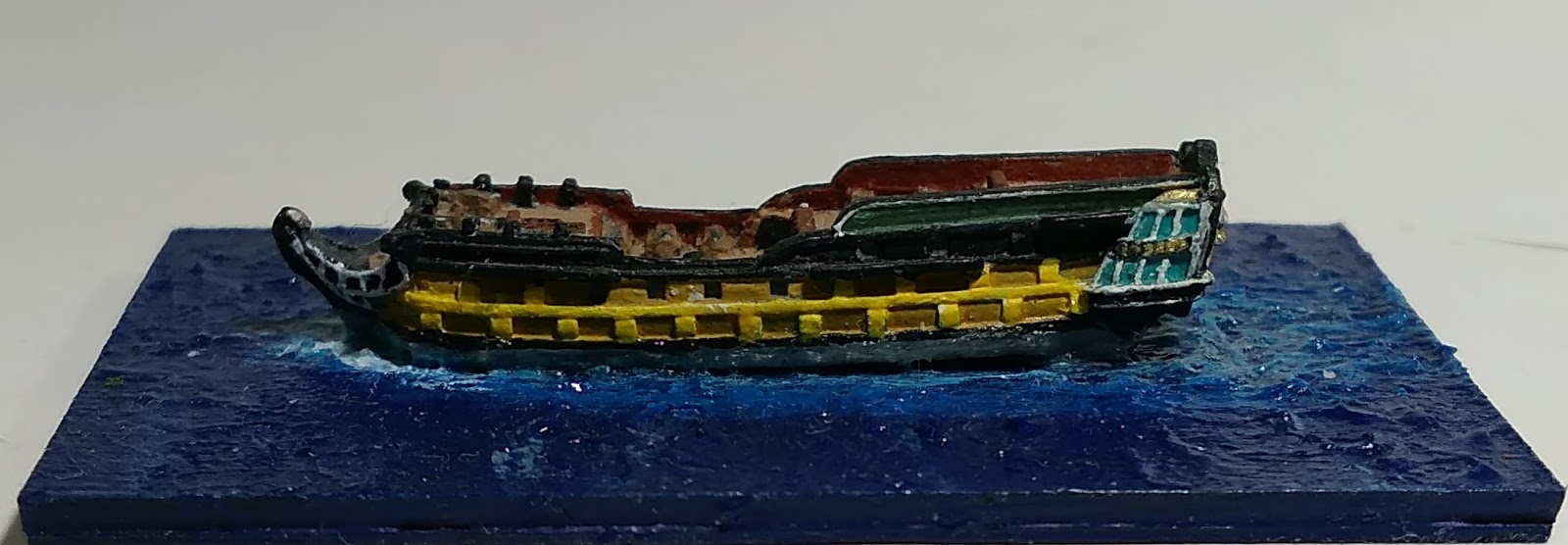
How Do You Say "Unicorn" in Russian?

Today's unicorn comes to us courtesy of the Russian Navy.  In all honesty though, she's not so much a unicorn as she is an odd duck.  I nicknamed my unfinished ships "unicorns" though, so we're sticking with that.

When I first bought this miniature, it was listed as "50 gun (2 deck)," which led me to think it was a ship of the line, just like a British 50.  Some time later, I purchased the book Russian Warships in the Age of Sail 1696-1860 by John Tredrea and Eduard Sozaev.

I've said it here before, but it bears repeating: this is
THE English language work on the Russian sailing navy. 
Not only is this an excellent reference work, but it reminds us that nations do things according to their own logic, whether it makes sense to us or not.  This 50-gun two-decker is an excellent case in point.  To us, it's a small ship of the line, like the famous/infamous HMS Leopard.  To the Russians, it's a frigate.  "Oh, OK" I hear you saying. "So she's just an old two-deck frigate like HMS Serapis."  Problem is, it's just not that simple.

According to Tredrea and Sovaev, these two deck 50+ gun frigates  were a series of one-off designs (unlike the Pyotr Apostol class of 46-gun ships) that were designed for operations in the Black Sea.  Referred to as "battle frigates" or "frigates of the line," the idea was that they could perform the functions of a frigate and then reinforce the line of battle once the engagement started.  You can see this from the armament carried.  Whereas Serapis carried 18 pounders on the lower deck and 9 or 12 pound guns on the upper, these Russian ships tended to be armed with 24 to 36 pounders on the lower deck, and anything from 12 to 36 pounders on the upper deck.  A "frigate of the line" indeed!  To use a more modern analogy: If the USS Constitution and her sister frigates were like a WWI battlecruiser, then these Russian frigates are more like a WWII pocket battleship.

With that bit of design history aside, below are some pictures of my finished model.  After looking at those, I'll talk about some of the issues with this particular mini.


 At first glance, you'd certainly think that he (the Russians call ships "he," not "she") looks like a small ship of the line.  Looking at pictures of this 50 gun frigate together with a 66 gun ship of the line might make you wonder even more about this ship.  So, here we go.

The 66 gunner is on the right of the photo.

The 66 gunner is only about 12 feet longer on the waterline.  What gives?
Interestingly enough, this resemblance to a ship of the line is the best clue as to what ship this mini represents.  As I said before, all of the 50+ gun two-deck frigates were one-off designs, so it can't represent all of them.  So, the "typical" large frigate of the Black Sea Fleet might have looked something like the drawing below:

This is Grigorii Velikiia Armenii [Gregory the Great of Armenia], a 50 gun frigate built in 1791.  He carried 28 30 pounders on the lower deck, and 22 18 pounders on her upper deck.  Note though, that he doesn't have 2 complete gun decks like the miniature.  So what ship was the miniature modeled on?

Personally, I think the miniature represents Krepkii [Strong], a 54 gun frigate built in 1801.  He carried 30 36 pounders on the lower deck and possibly 32 36 pound carronades on the upper deck (Tredrea says the carronades are conjectural).  There are no drawings or pictures of him, but Krepkii is listed as "a sister to the Baltic fleet line of battle ship Skoryi [Fast] (62)."  On Skoryi, the upper deck armament is confirmed as 36 pound carronades, so that does seem reasonable for Krepkii as well.

If I wanted to be uber-picky, then I would go on about some problems with the Langton miniature; however, I'm not going to do that.  Quite frankly, Russian Age of Sail ships are damned hard to come by.  Langton makes 6: a 100, a 74, a 66, this 50, a 44/46 two decker frigate, and a 32 gun frigate.  Red Eagle (formerly Skytrex) make a 100, 74 and a 36.  Navwar makes a 66.  It would appear then, that Russian ships are probably not big sellers.  So, rather than nitpicking, I think it's probably better to be happy with the choices we have.  Besides, the more I look through the book, the more I am convinced that the Langtons designed the 44/46 gun frigate miniature so that it could also do duty as the single gun deck 50s.  I will explain that a little more when I finish building my 44/46 gun mini:  AKA, the third unicorn.

Oh, and the answer to the question in the title?  The word "unicorn" in Russian is единорог, and is pronounced ye-dino-rog.

UPDATE: December 6, 2019.  These ships came up on a recent thread at The Miniatures Page.  A person named NotNelson1 was looking for information about the miniatures, so I pointed him here.  After reading the blog post, he asked me if I had asked the Langtons about what ships these were.  I had not. 😞  He did, and they told him that the 50 and 46 gun frigates were not based on any specific class of ships, but were representative examples.  So there you have it; all my speculation above is just that.  The Langtons did say that my estimations were as good as any, so I guess I've got that going for me. 😌  If anyone is interested, here's a link to that thread at TMP:


Sunday, January 28, 2018

Unicorn Hunting

This is not, unfortunately, a blog about visiting HMS Unicorn in Dundee, Scotland. (http://www.frigateunicorn.org/).  Instead, it's a post about some ships that have been on my "being built" list for a long time, and my plans for finally getting something done with them.

I started keeping track of my sailing ships miniatures with a spreadsheet in September of 2014.  In that first spreadsheet there is a page entitled "Under Construction" where I kept track of ships being built.  That first page listed the USS Pennsylvania, USS North Carolina, a Russian 46 gun frigate, a Russian 50 gun frigate, and 2 French 74 gun ships of the line.  Well, the latest version of the spreadsheet, which is dated 12/27/17 lists the following ships as "Under Construction":  The USS Pennsylvania, USS North Carolina, a Russian 46 gun frigate and a Russian 50 gun frigate.  After almost 3 and 1/2 years on the under construction list, I've taken to calling these ships "the unicorns."  One of my resolutions for this year is to reduce the size of this herd of unicorns.

All four of these ships were ordered for projects that did not materialize, or were not what I needed.  The two Russian frigates were bought in order to do an 1806 Black Sea campaign that is one of my favorite forgotten wars from the Age of Sail.  After buying them, I later bought the excellent reference book Russian Warships in the Age of Sail 1696-1860: Design, Construction, Careers and Fates by John Tredrea and Eduard Sozaev.  While a fantastic English language reference on the subject, it also let me know that all of the 46 gun frigates were out of service by 1800 in the Black Sea.  Along with that, the 50 gun two deck frigates were nearly extinct by the 1806 war.

If you're interested in the Russian navy during the Age of Sail,
then you MUST have this book.
So, the two Russian frigates, while needing only masts and rigging, became members of the unicorn fleet.
The 46 gun frigate

The 50 gun frigate, painted in the post-1801 scheme.
The Pennsylvania and North Carolina were bought for a "what-if" project, where war breaks out again between the US and UK in the 1820s or 1830s.  I don't know why this project went dormant but it did, and did so fairly quickly.  In fact, Pennsylvania is still on the painting stick, and is a long way from being finished.  North Carolina, however, is much like the Russian frigates where completion is concerned.

A little touch up here and there, some base work, and it will be time to put in the masts
(well, after I repaint them).  Maybe North Carolina is not as finished as I first thought.

Clearly then, this is the USS Pennsylvania. She's obviously a long way from
the water.
Part of the reason my "what-if" 1820s-30s project faltered is that the US ships really have a very limited usage outside of that.  As the pictures show, the hull shapes are very distinctive.  With their rounded bows and sterns along with other design features, they would look completely out of place in a line of battle with older ships.  With the black/white paint job and distinctive hull features, I suspect that these ships will spend most of their career fighting under Russian colors and not American ones.  However, no matter what their future careers may take them, I'm determined to cut down on the size of the unicorn fleet.

Monday, May 15, 2017

US, Russian and Dutch fleet photos

Here we have the smaller fleets in my collection: the Americans, the Russians, and the Dutch.  Since two of those three navies used white stripes for decoration, we have the above title.  Most people think that the white stripe along the gunports was a uniquely American paint scheme, but this isn't true.  In fact, the Russian Navy adopted the scheme first, during the period 1796-1801.

First up is the United States Navy.  The first pictures below are the Constitution.  Although I purchased this one, it is modified and somewhat repainted.  I added the gunports but as my latest book shows, even in 1812 she used the split gunports.  So, I need to change these at some point in the future.  Might be time to do a little bit of re-rigging as well.


Next up is the sister ship of the Constitution, the United States.  Also known as "The Old Waggon" due to her lackluster sailing qualities, I built this ship from another Constitution model.  I added the roundhouse on the upper deck and the additional galleries needed.  I based the stern on the old Revell model of the ship.

OK, so not all the US ships are painted with white stripes
Kinda proud of the stern, since I did it a good while back.
Now, I would probably add more detail.
 Next up is what Langton refers to as the USS Congress.  One of the original six frigates, Congress never had a very distinguished career.  She can however be used as her sister ship Constellation and I would even use her as Chesapeake, although she might not be completely correct.


Last up for the Americans is the USS Essex.  This mini was one I purchased.


The next act in our White Stripes get-together are the originators of the scheme, the Russian Navy.  Of course, not all of them are painted that way either, as you will see below.  First up is a 32 gun frigate:


This next ship is the oddball of the bunch.  Langton calls it a 46 gun heavy frigate, but the gunport arrangement doesn't match anything in Tredrea and Sozaev book, Russian Warships in the Age of Sail.  So, I'm considering it to be one of the 46 gun Pyotr Apostol class of frigates.  Since most, but not all of these, were out of service by 1800, I decided not to go with the black/white scheme.


The next unfinished ship is a 50 gun heavy frigate.  I haven't gone through the book trying to figure out which class this one is, but decided to give it the black/white treatment since there were large frigates around during the 1806 Russian-Ottoman war (which is my interest).


Next up is a 66 gun ship, which was the standard small SOL of the Russian navy.  These serve throughout the Age of Sail.


Like all other navies, the Russians built large numbers of 74 gun ships, and they see extensive service in both the Baltic and Black Sea theaters, along with the other areas the Russian navy ventured into.  For example, in 1798-1800 they actually cooperated with their long-time Ottoman enemies against the French!

A very no-nonsense looking ship.


The last ship for the Czar is the 100 gun three-deck SOL.  Even in confined waters like the Black Sea the Russians kept several of these.  This particular miniature probably represents a ship of the Ches'ma class, which may or may not be based on the design of HMS Victory.


Last in this post are my Dutch ships.  "Fleet" is a bit much, since I only have two ships.  There is not much information available in English on the painting and decoration of Dutch ships during this time, unlike the earlier 17th Century.  Before I build any more of this navy, I want to find more information.  These are painted based on information from the Langton website.

A 54/56 gun SOL. This one is riding a bit low in the water; might need to
redo this base.


A 64/68 gun SOL.  Dutch ships tended to be smaller than those of other nations.