Showing posts with label shore batteries. Show all posts

Monday, September 4, 2017

Real Estate!

No, this post is not going to tell you how to "flip" houses for a profit or make millions in real estate with no money down.  I'm pretty sure there are more than enough web sites and reality shows on the topic, if that's where your interests are.  Good luck to you and thanks for stopping by.

What this post is going to do instead is to talk about the kind of real estate navies have to deal with on occasion, and the models that represent them on the tabletop.  First up are forts.

While there is a huge difference (even in game terms) between an earth battery with a few guns and a brick fortress with dozens or more, a warship is best advised to avoid them all if they are unfriendly.  After all, even the great Lord Nelson allegedly said, "A ship's a fool to fight a fort."  Of course, he also said, "Desperate affairs require desperate measures."  With that in mind, let's take a look (or looks, as this will be more than one post) at some of the different terrain that naval gamers can expect to deal with.
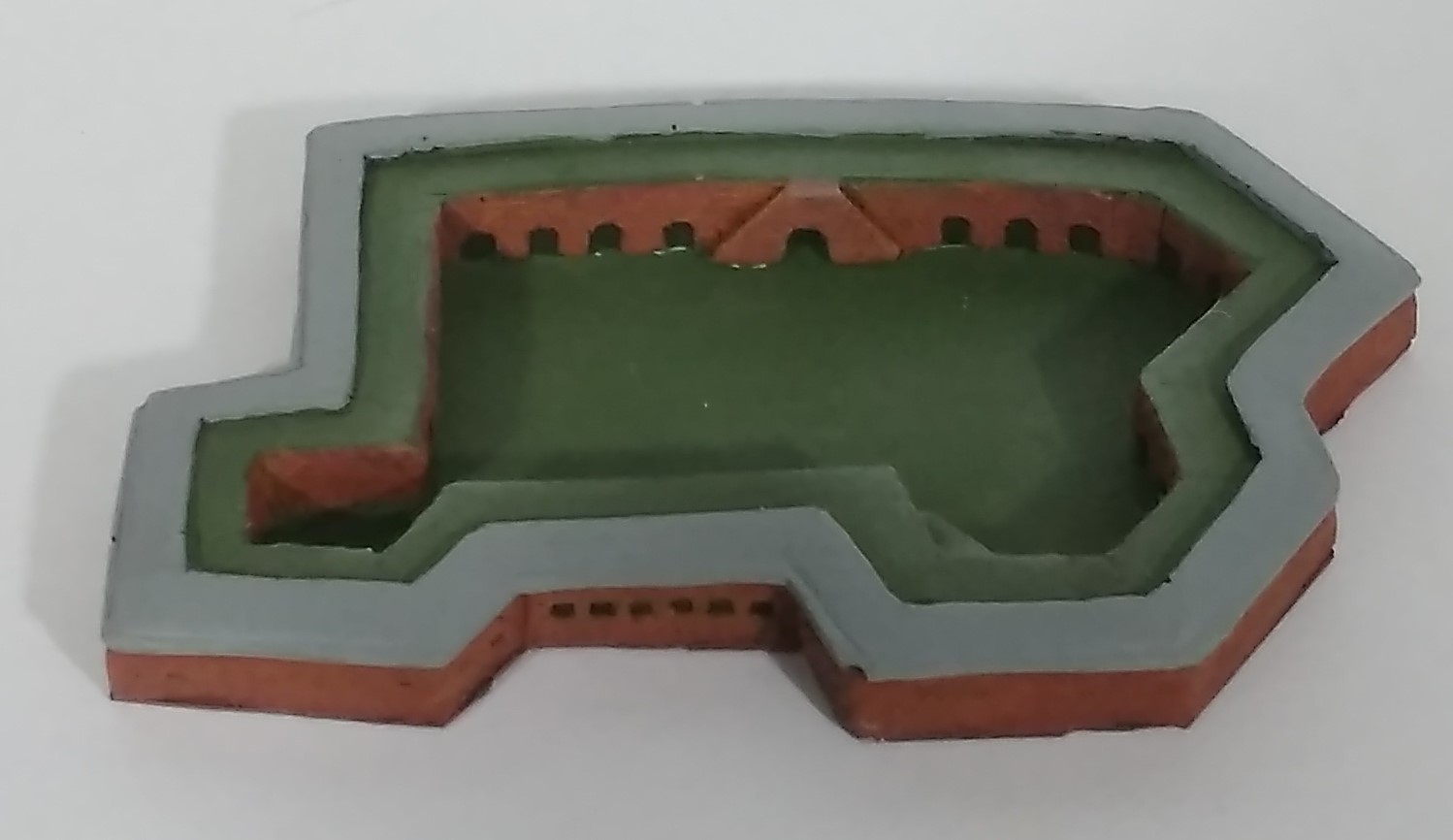
These are the big fortresses, those brick and mortar fortifications that represent the worst that a ship or fleet could possibly have to deal with.  I've got three of these, and will probably never need any more than that.  If anything, I should probably buy some more bomb vessels just to deal with these.  My first fort was bought at a convention flea market years ago.  It has no marking on it anywhere, and I think that it was not professionally made.  It is a generic fortress with 4 bastions, and I suspect that it might be based on Castillo de San Marcos in Saint Augustine Florida.  If that is the case, then my model needs a repaint as you can see below:

The original.  The walls may have started out as a tan color, but time has changed that.
In my defense, I did this a long time ago.
Next up are a pair of forts from Pithead/Spithead Miniatures 1/1200 American Civil War line.  They are forts Jackson and St. Philip that guarded the Mississippi River below New Orleans.  Saint Philip is the oldest of the two, having been built by the Spanish from 1792-1795.  It was then modified by the US from 1812-1815, and was besieged by the British during the War of 1812.  In the 1840s, the walls were thickened and strengthened.  An excellent summary regarding the changes in Fort St. Philip is located here: https://www.nps.gov/nhl/find/statelists/la/FortStPhilip.pdf .  The two models are made from a heavy black resin (polyester maybe), that at first appears to hide most of the detail.  However, an undercoat brings out the detail very nicely.  As a final note, the masters for these are hand-carved, not computer modeled.  If you prefer the perfection of a computer designed miniature, then these might not be for you.  However, I like the old-school vibe of these, and am planning on buying some Civil War ships from there as well.  This clip from a map depicting the 1812 battle shows the original form of the fort.


There are numerous maps of the fort in the Civil War, and all of them are different.  So this clip is taken from the 1921 plan drawn by the army.

Everything outside the fort should be ignored, as they are post Civil War additions.
Anyway, with the above drawings showing how the structure changed over time, I think you will see that the Pithead model does a good job of capturing the building itself.


While it doesn't represent the original 1815 fort (and shouldn't since it is a Civil War model), I think it will work fine for those times when you need something small, but strong and oddly shaped.

Next up on the list is Fort Jackson, which can also be used for Fort Morgan.  While this is not a Napoleonic fortress, being built from 1822-1832 it is the classic 5 sided star fort.


In a project like this, it's amazing what will trip you up at times.  When I painted the citadel/barracks, I presumed that the roof would be fireproof, so I painted it a slate color.  After some more digging, I found that the barrack roofs at both Jackson and Morgan were wooden.  The idea was that they would be covered with earth before an attack to make them bombproof.

The Saint Philip casting is one piece, where Jackson is 6 pieces; 5 wall parts and the citadel.  Consequently, Fort Jackson does take a little patience and greenstuff putty to make the walls fit together smoothly.  In all fairness to Pithead Miniatures though, this is clearly visible on the website picture of the unpainted version so it's not really a surprise.  To really nitpick, the citadel should be 10-sided and not round, as seen in the 1817 plan below.


I'm sure that the round version is easier to cast, and even in the plan it looks almost round.  Given that this one and the one at Fort Morgan burned during the battle, I don't think that a round casting is a deal breaker here.  I probably could make it look a little more multi-sided by filing the edges of the roof straight on each face, but didn't want to run the risk of messing up the citadel.

When will these get used?  Who knows.  However, when I do need them, I'm ready.  In the next real estate post, I'll take a look at things like lighthouses, signal stations and other less warlike structures.  You know, things that ambitious naval officers call "targets."

Monday, May 15, 2017

Shore Batteries from Stone Mountain Miniatures

Since I'm working on expanding things like my islands and shore batteries, I have been buying 1/1200 shore batteries from several different manufacturers.  The nice two-gun earth battery I got from Thoroughbred is in the ACW post, so I won't picture it again here.  Instead, I want to show off some more shore fortifications from a couple of other companies.

The first up are some shore batteries and large guns from Stone Mountain Miniatures.  While their ironclads are 1/1000 scale, I don't think that will make much of a difference where the shore forts are concerned.  So, I ordered the following items from them:
HSS 120: Dirt Shoreline Forts,
HSS 121: Dirt Fort Redoubts, and
HSS 115: Fortification Guns with Crew.

The forts are cast in a nice white/cream colored resin.  They have some nice detailing, as you can see in the photos.  I particularly like the steps leading into the batteries, as that is missing from the Thoroughbred one.  If I have to nitpick them, I would say that the info sheet included with them mentions wooden platforms for the guns, but there's no evidence of them on the casting.  As earthen batteries, they should fit into both the Age of Sail and Ironclad eras equally well.  I don't know if the one gun position will be of much use with my Age of Sail ships, but the other two should do sterling duty with them.


These are straight from the bag, no cleanup.


As always, these photos are larger than life size, and make the castings look worse than they really are. If the camera adds 10 pounds to a person, it certainly magnifies every bubble in a resin casting.  Remember too, that I did not clean these up before I took the photos.

Next up is HSS 121, the Dirt Fort Redoubts.  They also come three to a package, but as they are all identical I'm just showing pictures of one.  They're made from the same resin as the forts, with about the same level of details.  There is a nice extra with these, though, and that is a set of guns and gunners.


Once again, these are straight from the bag.


Now, the photos make these guns and gunners look REALLY bad.  That's because of how small these castings are.


Recolor this, and you could call it a new "Face on Mars"
So, how small are they?  Well, here's a picture of a gun casting and the Quarter of Comparison™

Looks a LOT better in comparison. And still a lot larger than life sized.
The last thing in this review is HHS 115: Fortification Guns and Crew.  This is a bag of heavy guns, but they are not generic.  Below is the sheet that comes in the bag:


Three distinctly different types of guns?  That's a pretty big claim, so let's see what they look like:

L to R: Columbiad, Rodman, Parrott.
I thought about putting a closeup of each gun, but having done that earlier in this post, I don't really think it's fair to the castings.  You can see from the picture above that each of the guns is different, and the Parrott even has the band around the breech.  Just in case the Quarter of Comparison™  above didn't tell you enough, below is one of the castings on my thumbnail:
All in all, I think they are a pretty useful addition, and I would recommend them for players of sailing ships and/or ironclads.  You can find them at: http://www.wargamingminiatures.com/wargaming-figures/houstons-ships-fortifications/ .  And in interest of full disclosure, I bought these myself and Stone Mountain Miniatures did not know I was going to write about them.

Saturday, April 15, 2017

Ironclad Interlude

After a few weeks of travel and being away, I'm back at the blog.  In this post are some photos of the ironclads I showed off in the "Getting My Hands Dirty?" post back in March.

After thinking about it, and some discussion over at TMP, I've decided that I am going to have to base these ships as well.  Compared to the sailing ships, these ironclads are mere slips of metal and I think that bases will be much easier in moving them.   Also, some of the gunboats are easily under 100 feet long, so less than 1 inch in 1/1200 scale.  In a way, it's the opposite of the sailing ship problem; instead of being top heavy, they are so small that a sneeze might blow them away (or at least the resin ones).

Unlike the sailing ships though, these are going to be on clear bases.  Given that Civil War ship operations go back and forth between rivers and deep water, I don't want to own one set of ships on ocean bases and one set on river bases.  While I realize that I could use my ocean mats for riverine scenarios, this is an area where traveling has convinced me otherwise.  After looking at various rivers during my trip to Virginia, one thing I can say is that rivers aren't blue!  Brown, green or some mixture of the two, but not blue.  I'm thinking about going with this mat for my rivers: http://cigarboxbattlestore.bigcartel.com/product/full-river-4x6-plus-230 as it would let me place land on top of it while still having a very wide river if that were to be needed for a scenario.

Below are some photos of the ironclads after they've been painted.  While I'm happy enough with how the two Monitors came out, I'm not as happy with the CSS Atlanta.  I just don't think that I did justice to all the fine details that Thoroughbred put into the model.  For the moment I'm consoling myself with the fact that the pictures show the ship at much larger than full size, thereby magnifying my sloppy brushwork.
USS Weehawken
Obligatory shot with US quarter
USS Nahant. You can see why the different markings are necessary.
Their opponent, CSS Atlanta. The flagpole is removable so she can be the
USS Atlanta
as needed.
Even this ship is not particularly tall, as the quarter shot shows.
Toby Barrett at Thoroughbred was nice enough to send me a little extra with the order, which was a 2 gun earthen battery.  So, those pictures are below.

It actually looks a lot better in person.  This photo makes the color look
like dog poop brown.
I tried to make the mud around the guns a slightly different color,
to show it being stirred up by people moving around.
I think it worked pretty well.
The detail is very nice.  This flagpole is also removable.
So all that remains now is to get in a game, and see what we think of the rules I've chosen.  Right now, I am going with Sail and Steam Navies, which appears to be well thought out, while still having as much detail as the old Ironclads game by Yaquinto.